
Why Canadian Constitutional Law Exam Feels Deceptive

The confidence trap
There is a particular kind of confidence that Canadian Constitutional Law creates when you study it.
To be fair, that confidence is not entirely misplaced. The subject, at least on paper, appears organized. You read about federalism, the Charter, the division of powers, and everything seems to sit in its own place. Each doctrine appears to have its own structure, its own test, and a sense that once you identify what you are dealing with, the rest is simply a matter of applying it.
That is the impression most students carry into the exam. And that is exactly where things begin to come apart.
What looks straightforward, may not be
The law and the doctrines do not change. What changes is the way they intersect inside a fact pattern. On paper, doctrines are taught in isolation.
However, on the exam, they rarely operate that way.
The same set of facts can point in more than one direction at the same time. Something that appears to be a single-dimensional issue may, on closer reading, turn out to be multi-layered which is incomplete without an additional doctrinal approach.
For example, consider a situation where a provincial law regulates an activity that is closely connected to a federally regulated undertaking.
At first reading, this appears to be a straightforward case where both levels of government may have a legitimate interest in regulating the same subject matter. A student may therefore approach it through the double aspect doctrine, i.e., both laws can co-exist, each addressing a different aspect of the same activity.
But the reality is that the same facts rarely stay confined to that one line of thinking. They may just as easily pull the analysis in a different direction altogether.
The facts will give signs which would beg additional questions such as: whether the provincial law merely overlap with the federal domain, or does it go further and intrude into an area that is meant to remain protected? And, even if both laws are valid and applicable, does one undermine the purpose of the other?
Whats noticable here is that even though these questions arise from the same set of facts, these are questions must be addressed indpendently. They are different analytical paths, each leading to a different outcome.
Now, the difficulty is not identifying them, but identifying and deciding which additional question are the facts actually pointing towards — and resolving that choice before writing anything.
What actually happens in the exam
Consider the same situation — a provincial law regulating something closely connected to a federally regulated undertaking.
Recall that at first reading, it feels manageable. The structure appears familiar, and the instinct is immediate:
“This looks like a case where both levels of government are involved… this should fall under the double aspect doctrine.”
The student is working within a time-sensitive exam. A quick plan is formed, and the writing begins almost without any mental resistance. The framework is set out, the test is applied, and the analysis starts to take shape with a certain confidence.
For a while, everything feels under control. Much Later into the writing, something doesn’t sit right.
A detail in the facts pulls against the direction the answer has already taken. This was not obvious initially. Now, while it may not immediately break the structure, it is enough to create hesitation in the student’s mind:
“Wait… is this really just an overlap?”
THAT IS THE MOMENT!!
At this point, the student has a choice: continue with what has already been written, or step back and reconsider the entire approach.
Some step back. Some don’t.
But either way, they have to adjust — and that adjustment comes with pressure: Time is already running.
They either go back, restart, and rewrite the analysis. Or, they introduce another line of reasoning, bringing in an additional doctrine without clearly resolving the first.
However,both approaches create the same problem: Loss of time & control!
The answer becomes longer, obviously more but unnecessarily detailed. Sometimes it may even be more sophisticated on the surface. But it no longer has a direction.
The reason is that although the structure, the language, and the doctrinal application are still correct, the answer is now moving directionless which means reaching at a concrete conclusion is rarely plausible.
The real problem is that by the time corrections happen, the cost is already visible: time is gone & the flow is broken.
And the irony is that throughout all of this, the student still thinks that everything is under control. Why — because they know the doctrines, understand the tests, and are writing endlessly. This makes it hard to realize that the answer might be collapsing.
What the exam is actually testing
To cut a long story short: the exam is not testing how much you can write, or how many doctrines you can mention.
It is testing whether you chose — and planned — correctly before you began.
Once that choice is wrong, everything that follows — no matter how well written — is built on the wrong foundation.
That is why even strong answers still lose marks.
The key takeaway
In Constitutional Law, the quality of your answer is determined before you begin writing it.
Move from reading to real practice
More on Constitution Law
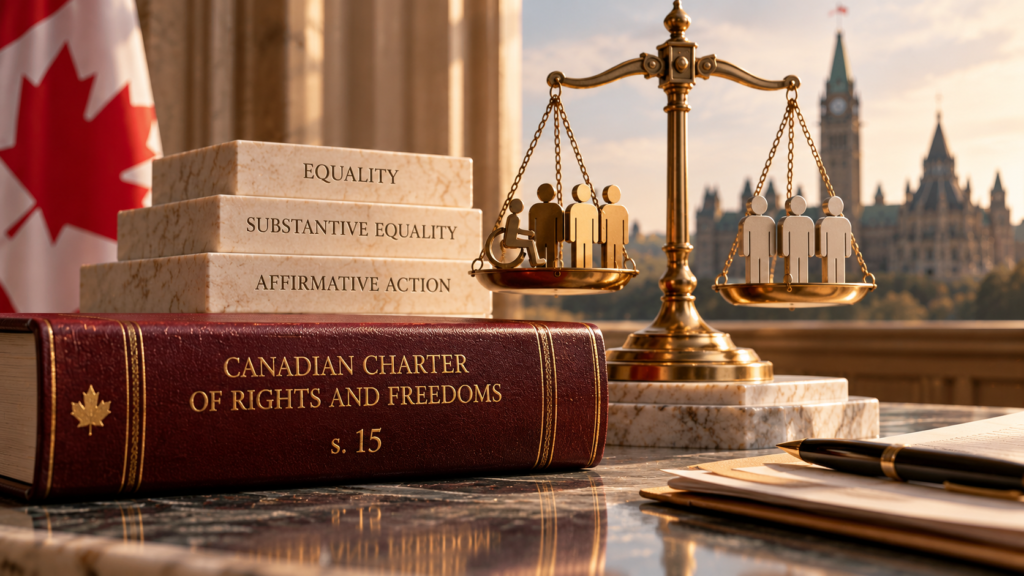
Affirmative Action and Section 15(2): Why Equality Does Not Always Mean Equal Treatment
The Charter Breach Is Obvious. What Exactly Should the Court Fix?

The Province Calls It Consumer Protection. Does That Matter?
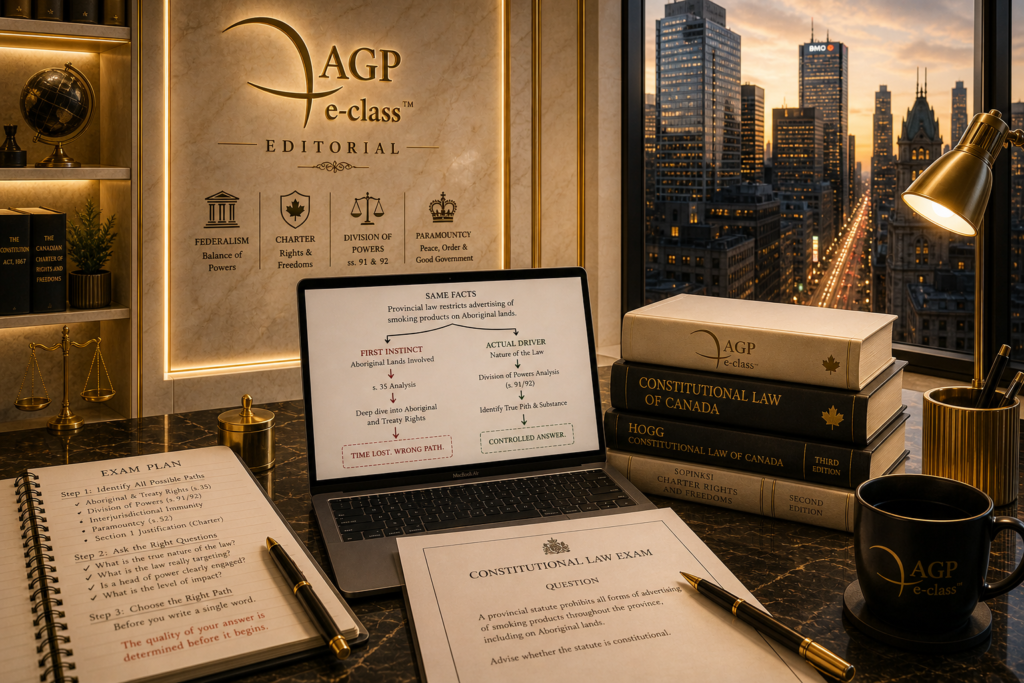
Why Canadian Constitutional Law Exam Answers Fail Even When You Think You Know the Law
Continue Exploring the Editorial
Why Canadian Constitutional Law Exam Answers Fail Even When You Think You Know the Law

Canadian Administrative Law Exam Is Not What You Think It Is | AGP – eclass™
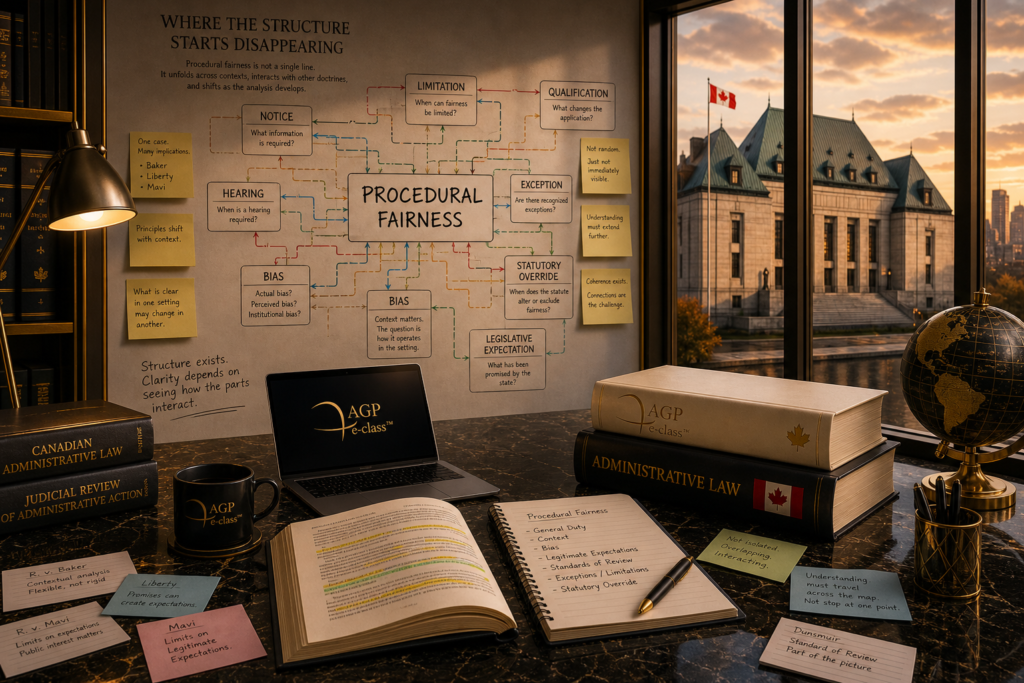
Why Procedural Fairness Often Feels Scattered | AGP e-class™

The Structure Behind Canadian Administrative Law | AGP e-class™ Lawbrary

Why Canadian Administrative Law Feels Confusing | AGP e-class™
AGP e-class™ Student Insight Briefing
Follow the public conversation
Editorial pieces, professional opportunities, cohort updates, and Canadian law pathway signals.
Receive selected student updates
Important notices, new Editorial pieces, cohort information, and timely professional signals.
Watch deeper legal briefings
Long-form guidance on Canadian law, the NCA pathway, legal reasoning, and professional readiness.