
Canadian Administrative Law Exam Is Not What You Think It Is

The Confidence Students Walk In With
There is a certain kind of confidence that many students carry into the administrative law exam.
It is not entirely misplaced. They have studied the material, attended lectures, and worked through the core doctrines. They recognise procedural fairness, they can identify the standard of review, and they are able to spot the issues that appear on the page.
At that stage, the subject feels manageable. However, this confidence assumes that once an issue is identified, the task that follows is relatively stable — that the correct rule can be attached, applied, and carried through in a largely predictable way.
The difficulty is that the administrative law exam does not consistently reward that form of thinking.
The Fundamental Misreading of the Exam
The core difficulty in the administrative law exam does not arise from a lack of effort or familiarity with the material.
It arises from a particular way of reading the problem.
Most students follow the popular advice that Administrative Law is that it is built around discrete, self-contained concepts. That, each issue is treated as something that can be identified, paired with a rule, and resolved without significantly altering the rest of the analysis.
While that instinct is not entirely wrong, and, in some areas of law, it works reasonably well, in administrative law, however, it begins to fail.
The reasoning often proceeds on the assumption that once a rule has been identified, its content remains stable, i.e., the doctrine is treated as if it carries a fixed meaning that can simply be extended across the problem.
However, in administrative law, what appears to be a stable rule does not remain entirely fixed once it is carried into the setting of the decision. Its meaning begins to shift — not arbitrarily, but in response to the context in which it is being applied. The issue is that this becomes visible to the student too late, i.e., at the point where the answer marches beyond identification.
At the identification stage, most answers appear strong. The doctrines are recognised, the principles are stated, and the structure appears sound. However, this above assumption is precisely what starts the breaking of the answer.
What’s more dangerous: what follows next, makes the answer lose control.
A Simple Issue That Is Not Simple
Consider a situation in which a student identifies a potential breach of procedural fairness because an individual was not given a full opportunity to respond.
At a surface level, the conclusion appears straightforward. There is a duty, and there appears to be a limitation on participation.
However, that is rarely where the difficulty lies. Furthermore, this difficulty begins when that initial observation is carried forward.
This is because what appears restrictive in one situation does not necessarily operate in the same way in another. The rule does not disappear, but it does not remain uniform either. Its significance begins to change as the decision-making setting becomes clearer.
The point at which many answers begin to lose depth shows when the issue has been identified correctly, but the reasoning does not adjust with the problem.
The reason is simple: what seemed sufficient at the beginning no longer holds once the analysis is pushed further.
In other words, the distinction does not come from the rule alone. It emerges from how that rule begins to interact with the surrounding context.
What the Exam Is Actually Testing — and Why It Feels Unpredictable
What the exam appears to be testing is often misunderstood as the ability to reproduce legal principles. In administrative law, a student who treats the law as a set of fixed rules will tend to produce answers that though may be technically correct, more often than not, lack depth.
The structure is often neat, the doctrines are accurately stated, and the issues are properly identified. However, the analysis remains confined to applying those doctrines as if their content were stable across situations.
This is where answers start to fail. An A grade slips into B. The difference between the two levels of answers becomes visible in how the reasoning holds — or fails to hold — once it is carried through the facts.
Two students may cite the same principles and even reach similar conclusions, yet one answer demonstrates a deeper engagement with how those principles adjust to the facts at hand, while the other treats them as static propositions. The difference lies not in knowledge, but in the training received that built the ability to analyze & apply the structure of the law.
It is this demand that often leads students to describe the exam as unpredictable or unusually difficult. In reality, the exam is not introducing randomness. It is exposing the limits of a preparation strategy that focuses on isolated rules rather than their interaction.
When preparation is oriented toward memorizing doctrines, fitting those doctrines into boxes, the exam appears to shift unexpectedly because the student encounters situations where those doctrines do not apply in a straightforward manner. However, when preparation is grounded in understanding how principles operate across varying contexts, the same exam begins to feel structured and coherent.
The perceived unpredictability, therefore, is not a feature of the exam itself. It is a reflection of the gap between how the subject is studied and how it is tested.
This discussion is part of a broader attempt to examine how legal reasoning actually holds — or breaks — in exam conditions.
Move from reading to real practice
More on Administrative Law
Continue Exploring the Editorial
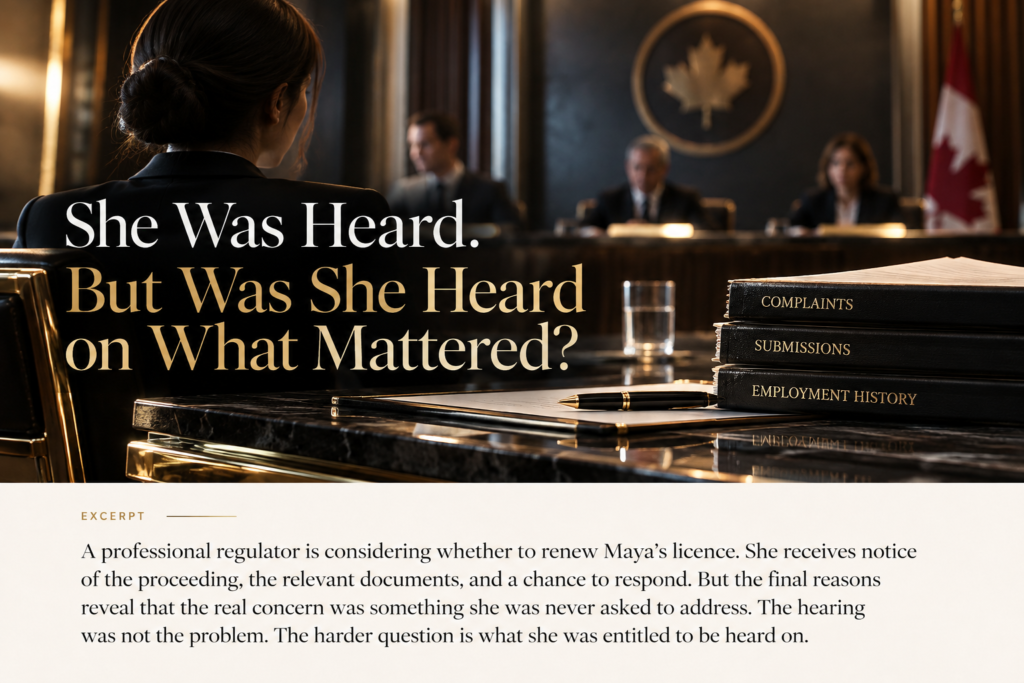
Procedural Fairness: Is a hearing always enough?

Affirmative Action and Section 15(2): Why Equality Does Not Always Mean Equal Treatment
The Charter Breach Is Obvious. What Exactly Should the Court Fix?

The Province Calls It Consumer Protection. Does That Matter?

Why Canada Is Rethinking the Bar Exam, and Why Candidates Should Care

The McKee Files | Episode 5: Who Decides What the Defence Gets to See? | AGP e-class™

The McKee Files | Episode 4: When Privacy Meets the Right to a Defence | AGP e-class™
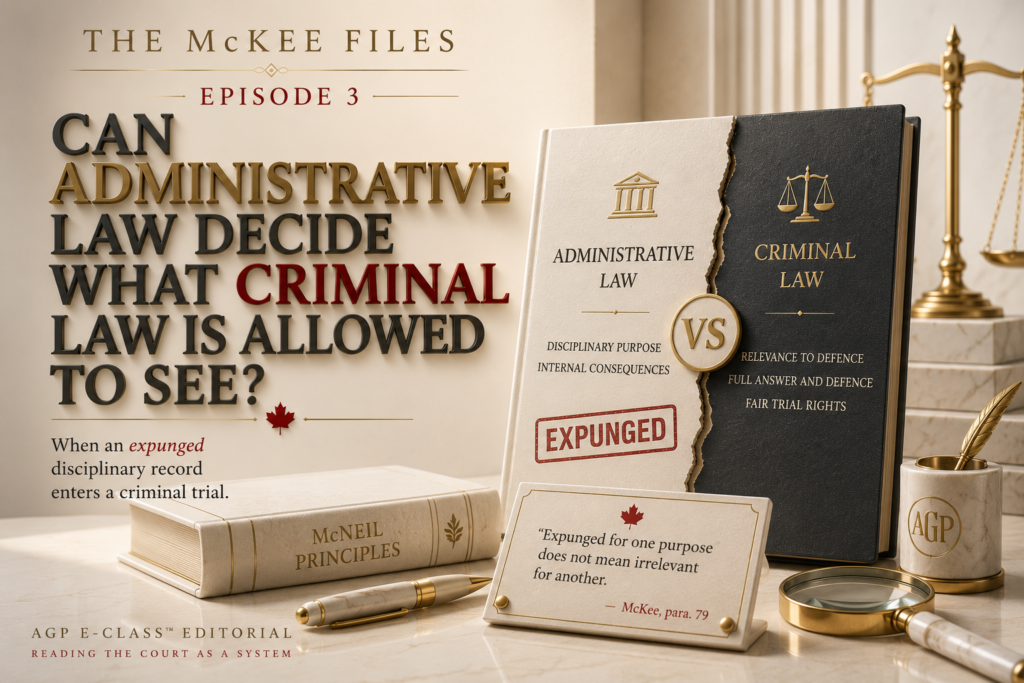
The McKee Files | Episode 3: Can Administrative Law Decide What Criminal Law Is Allowed to See?
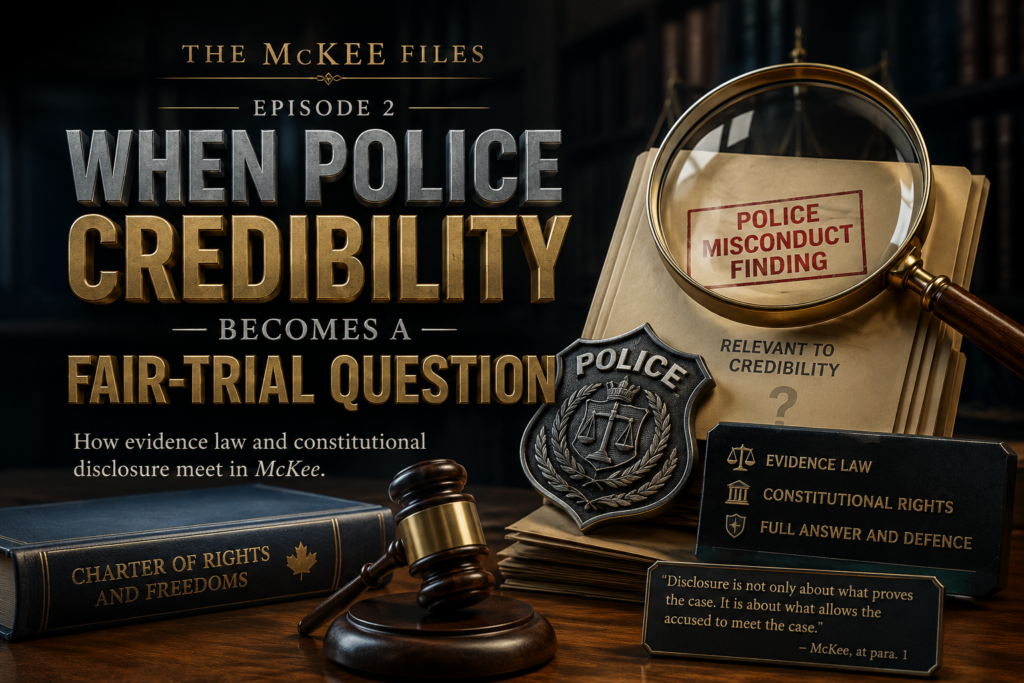
The McKee Files | Episode 2: When Police Credibility Becomes a Fair-Trial Question
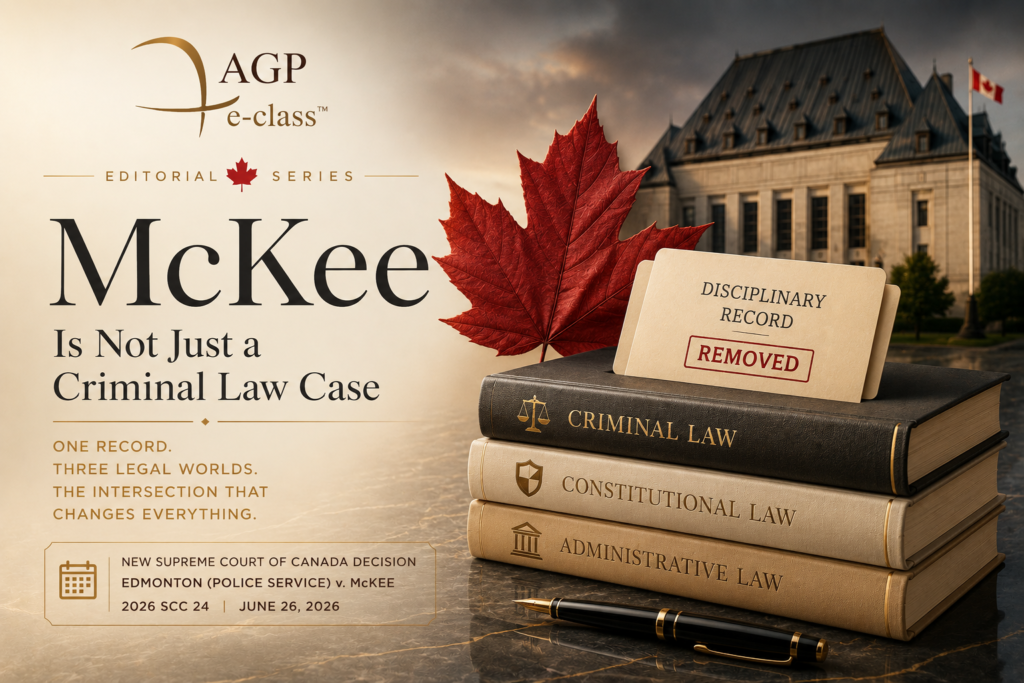
The McKee Files | Pilot: McKee Is Not Just a Criminal Law Case | AGP e-class™

Why Passive Reading Is Not Exam Preparation | AGP e-class™

Why Canadian Constitutional Law Exam Answers Fail Even When You Think You Know the Law

Why Canadian Constitutional Law Exam Feels Deceptive | AGP e-class™
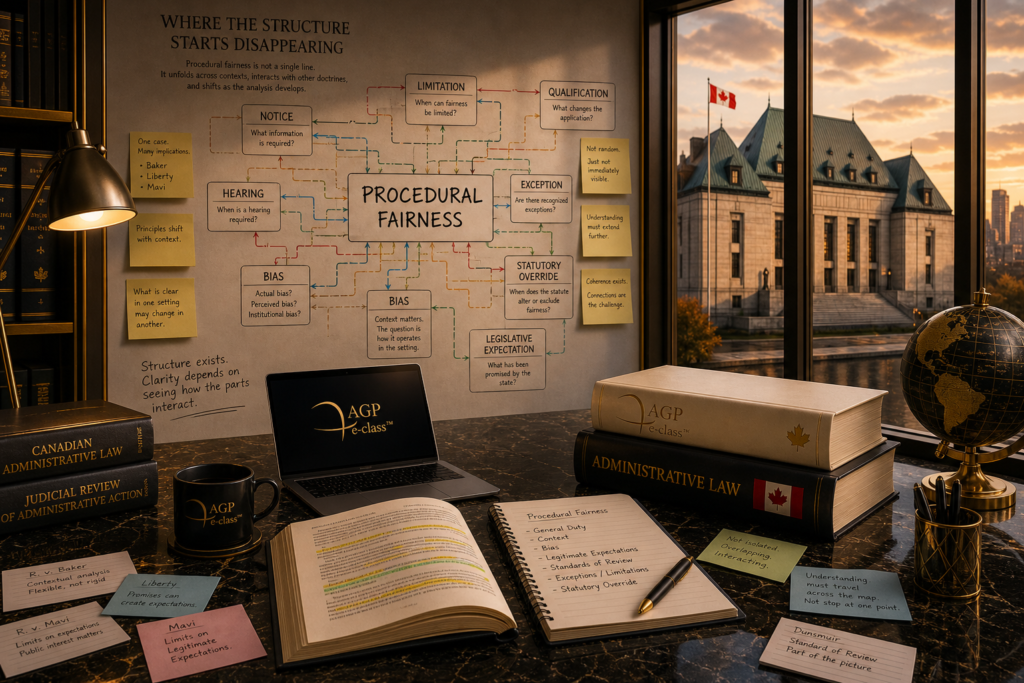
Why Procedural Fairness Often Feels Scattered | AGP e-class™

The Structure Behind Canadian Administrative Law | AGP e-class™ Lawbrary

Why Canadian Administrative Law Feels Confusing | AGP e-class™
AGP e-class™ Student Insight Briefing
Follow the public conversation
Editorial pieces, professional opportunities, cohort updates, and Canadian law pathway signals.
Receive selected student updates
Important notices, new Editorial pieces, cohort information, and timely professional signals.
Watch deeper legal briefings
Long-form guidance on Canadian law, the NCA pathway, legal reasoning, and professional readiness.