
Why Procedural Fairness Often Feels Scattered
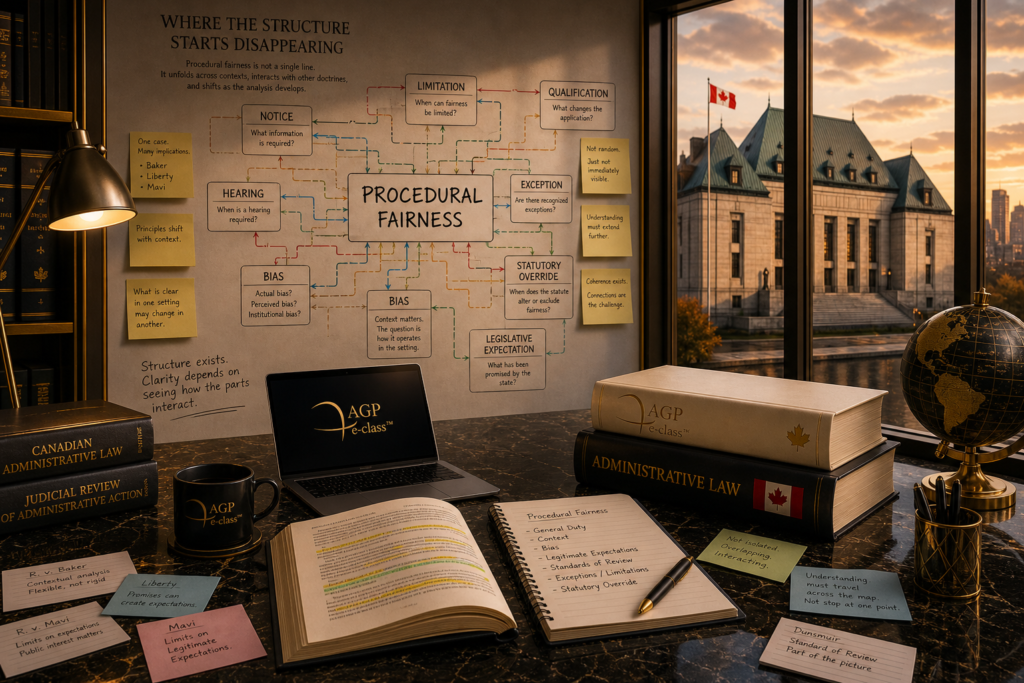
Where the Structure Starts Disappearing
Canadian administrative law does, at a distance, appear to have structure. Once that structure begins to come into view, doctrines that once felt disconnected start to make a certain kind of sense.
But that clarity does not always hold. The moment students step into procedural fairness, something shifts.
The structure that seemed visible a moment ago becomes harder to track.
Procedural fairness rarely presents itself as a single, contained doctrine. Instead, ideas appear across different parts of the subject, in different contexts, and at different stages of the analysis. What is encountered first does not always remain stable when it reappears later.
The result is a doctrine that often feels scattered.
The General Duty — and Everything That Complicates It
Procedural fairness often begins with what appears to be a simple proposition: a general duty owed by public decision-makers.
At first glance, that principle seems manageable. Where decisions affect individuals, fairness is expected.
But the doctrine rarely remains at that level.
As the analysis develops, the initial idea begins to shift once it is placed within the setting of a particular decision. What appeared straightforward begins to depend on how the decision is made, the context in which it arises, and the way its effects are experienced.
Even where these considerations seem clear on their own, they do not operate independently. They interact, overlap, and sometimes pull in different directions.
Very quickly, the starting point becomes surrounded by qualifications, limits, and further adjustments that do not always appear together in one place.
This is why procedural fairness often feels far more complicated in practice than the principle itself suggests.
That complexity is not confined to the general duty alone. It appears across the doctrine — in questions of bias, in expectations created by decision-making processes, and in the way fairness is assessed in particular situations.
When One Case Begins Doing Several Things
Another source of difficulty lies in the way the jurisprudence develops.
Administrative law cases rarely resolve a single issue in isolation. A decision that is cited for one proposition often carries implications elsewhere.
The well-known Baker decision, for instance, is frequently associated with how fairness is assessed in a given situation. But its influence does not remain confined to that point. It shapes how related questions are approached, even when those questions appear to belong to a different part of the analysis.
Similarly, decisions such as Liberty or Mavi, often discussed in the context of legitimate expectations, do not remain limited to that doctrine. They interact with broader questions about how procedural protections arise, how they may be limited, and how decision-making processes are understood.
What emerges is not a single line of development, but overlapping strands.
Students encountering these cases for the first time often find themselves dealing with several doctrinal threads at once. Without a clear sense of how those threads relate, the subject begins to feel unstable.
Procedural fairness, in that sense, does not unfold as a single set of rules. It develops through ideas that overlap, extend, and sometimes reshape each other.
Each concept — notice, hearings, bias, legitimate expectations — can be understood in isolation.
The difficulty begins when those ideas are carried across a wider body of cases. At that point, what seemed manageable begins to fragment.
Where the Difficulty Actually Lies
The challenge of procedural fairness does not lie in any single concept. It lies in what happens when those concepts are no longer encountered on their own.
As the ideas begin to interact, the earlier understanding that felt sufficient starts to give way. What appeared clear in one setting does not necessarily hold in another.
This is the point at which many students begin to feel that the doctrine lacks coherence.
But the issue is not randomness.
It is that the connections between these moving parts are not immediately visible when the subject is studied piece by piece.
And that is where most preparation begins to fall short — not in what is studied, but in how that understanding survives when the problem begins to change.
Move from reading to real practice
More on Administrative Law
Continue Exploring the Editorial
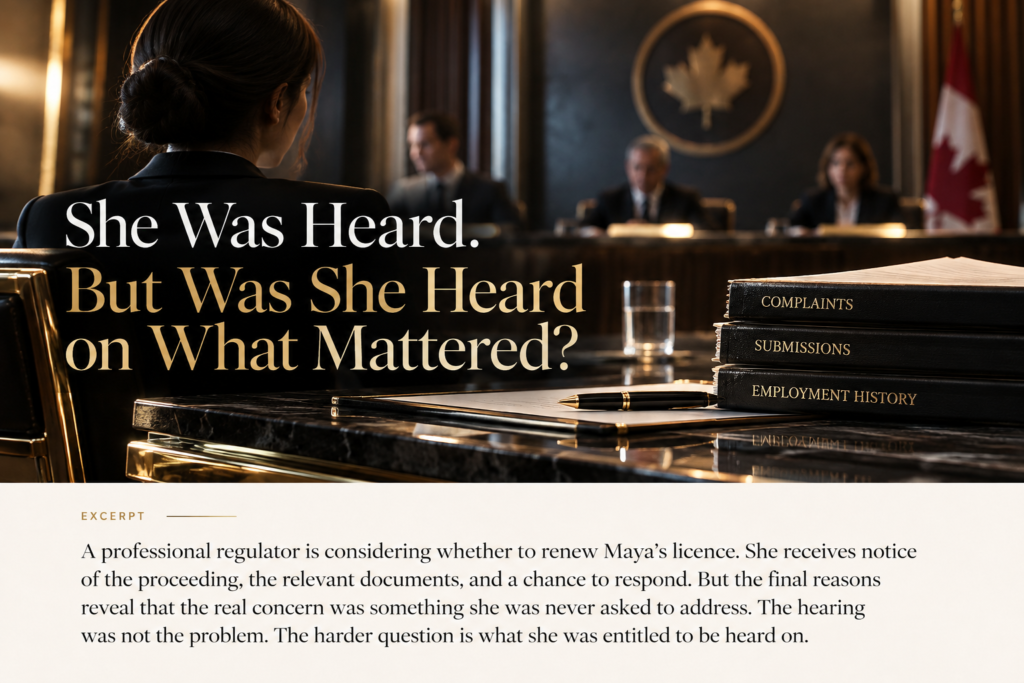
Procedural Fairness: Is a hearing always enough?
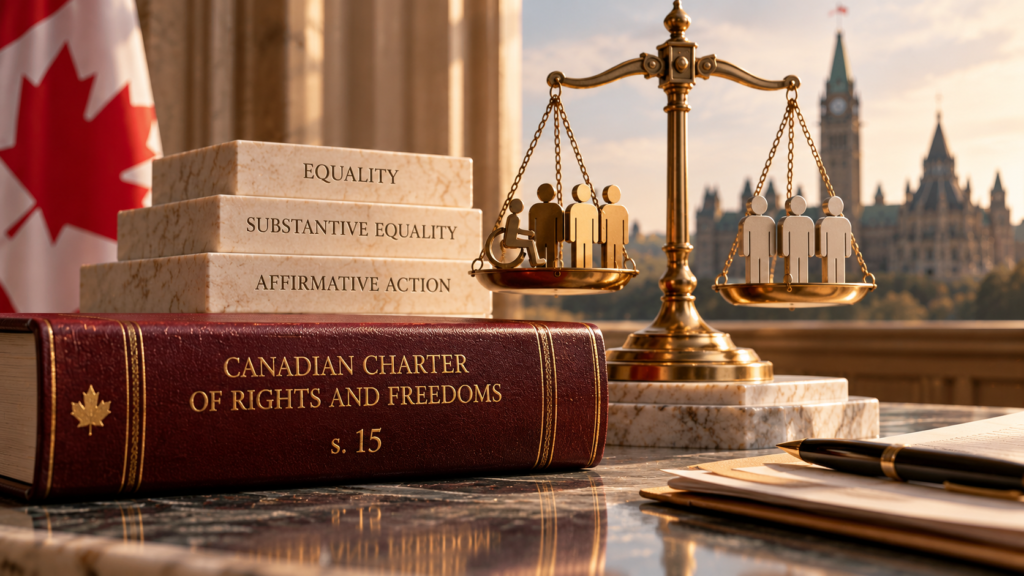
Affirmative Action and Section 15(2): Why Equality Does Not Always Mean Equal Treatment
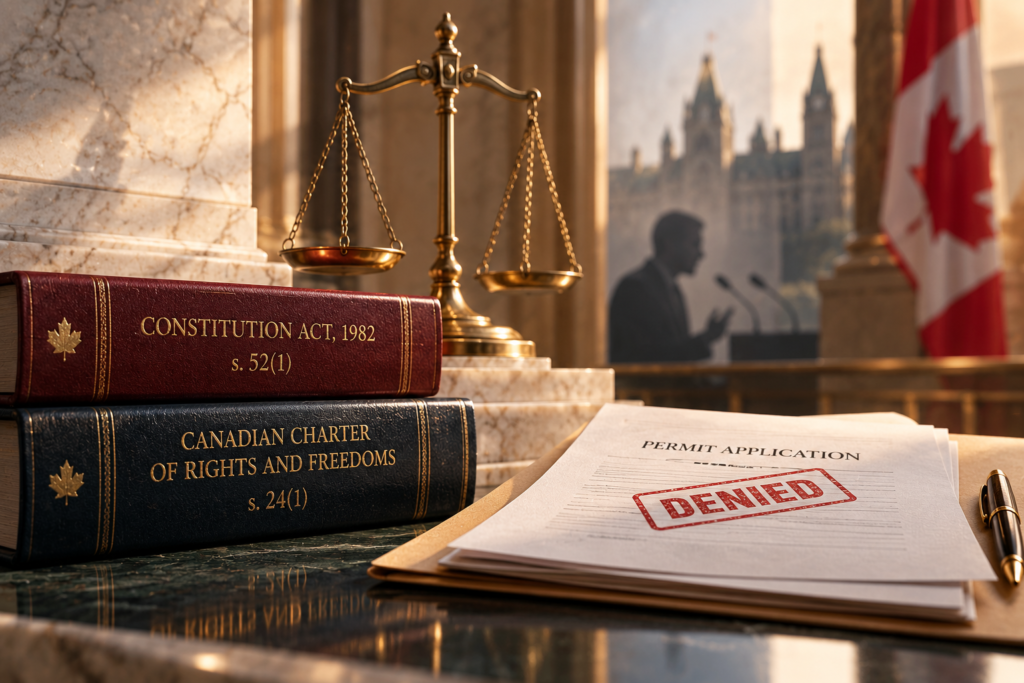
The Charter Breach Is Obvious. What Exactly Should the Court Fix?

The Province Calls It Consumer Protection. Does That Matter?
Why Canada Is Rethinking the Bar Exam, and Why Candidates Should Care

The McKee Files | Episode 5: Who Decides What the Defence Gets to See? | AGP e-class™

The McKee Files | Episode 4: When Privacy Meets the Right to a Defence | AGP e-class™
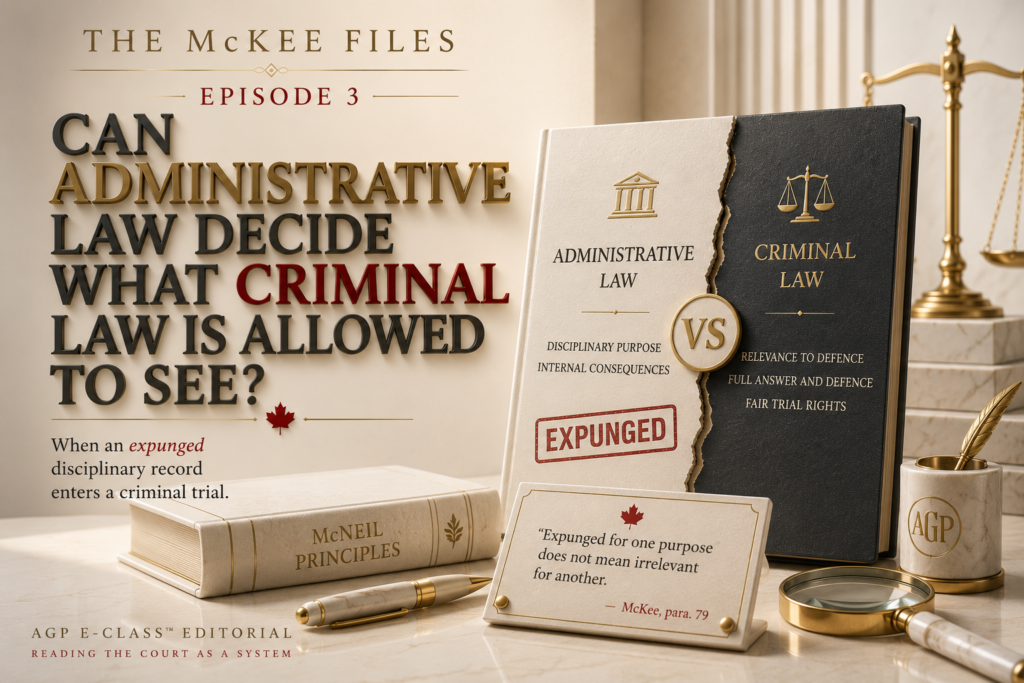
The McKee Files | Episode 3: Can Administrative Law Decide What Criminal Law Is Allowed to See?
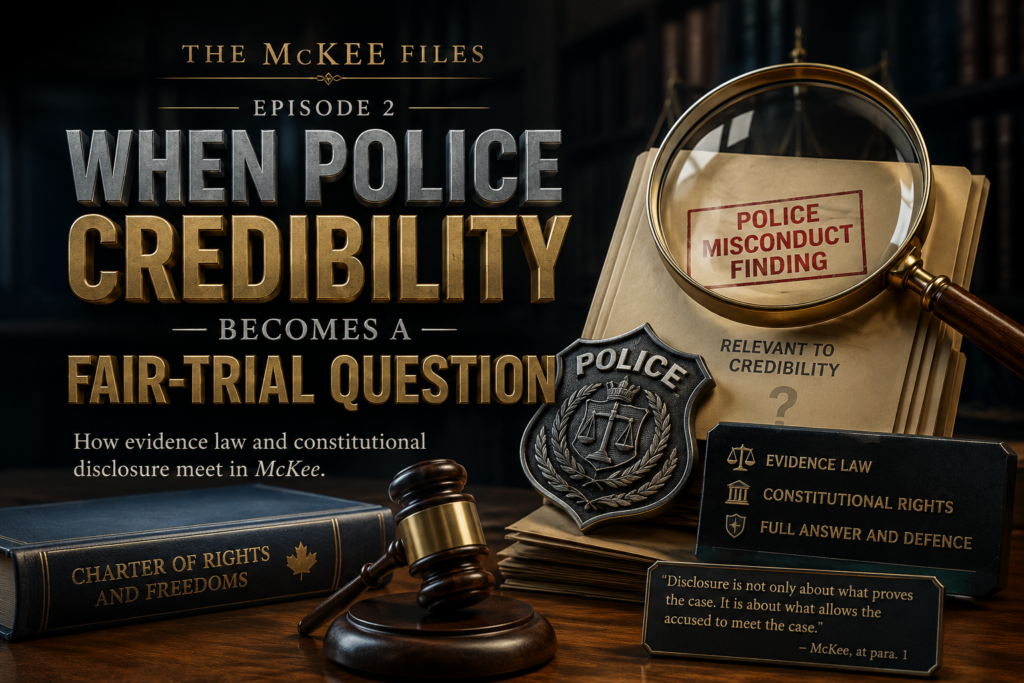
The McKee Files | Episode 2: When Police Credibility Becomes a Fair-Trial Question
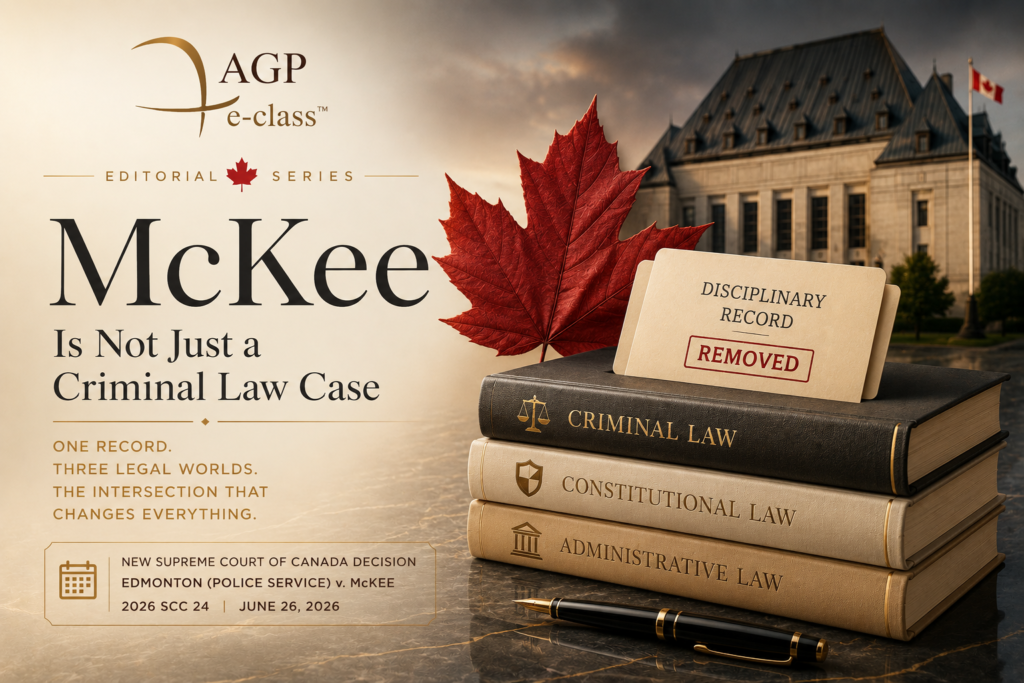
The McKee Files | Pilot: McKee Is Not Just a Criminal Law Case | AGP e-class™

Why Passive Reading Is Not Exam Preparation | AGP e-class™

Why Canadian Constitutional Law Exam Answers Fail Even When You Think You Know the Law

Why Canadian Constitutional Law Exam Feels Deceptive | AGP e-class™

Canadian Administrative Law Exam Is Not What You Think It Is | AGP – eclass™

The Structure Behind Canadian Administrative Law | AGP e-class™ Lawbrary

Why Canadian Administrative Law Feels Confusing | AGP e-class™
AGP e-class™ Student Insight Briefing
Follow the public conversation
Editorial pieces, professional opportunities, cohort updates, and Canadian law pathway signals.
Receive selected student updates
Important notices, new Editorial pieces, cohort information, and timely professional signals.
Watch deeper legal briefings
Long-form guidance on Canadian law, the NCA pathway, legal reasoning, and professional readiness.