
Why Canadian Administrative Law Feels Confusing
Until You See the Structure

Canadian administrative law has gained a certain reputation: confusing.
Students encounter a long list of doctrines — duty of fairness, bias, legitimate expectations, natural justice, reasonableness, correctness — and the subject often feels like a collection of disconnected rules.
At first glance, these pieces do not seem to belong to the same system. One appears to deal with procedure, another with impartiality, another with the intensity of judicial review. Cases introduce exceptions, qualifications, and new terminology. It is easy to begin treating administrative law as a catalogue of doctrines to be memorised, even while the NCA syllabus asks students to focus on the “big picture.”
But the confusion is not caused only by the number of doctrines.
It often comes from the way they are approached.
When each concept is studied in isolation, the subject naturally begins to feel fragmented. The difficulty is not simply that there are many rules, but that the connection between them is not immediately visible.
Administrative law begins to feel more coherent when the student starts to see that these doctrines are not operating independently. They are different legal responses to the exercise of public power — how decisions are made, how decision-makers remain within lawful limits, and how those decisions are assessed when challenged.
That does not mean the subject becomes simple.
The doctrines do not collapse into one rule, nor do they reduce to a single formula. Procedural fairness, bias, legitimate expectations, reasonableness, and correctness continue to operate in distinct ways. But they begin to appear less like isolated topics and more like parts of a structure that must be understood together.
This is where many students experience a shift.
What initially appears to be a maze is not merely a maze. But it does not become straightforward either. It becomes something that requires a different kind of understanding — one that does not come from memorising individual doctrines alone.
And that shift is often the difference between recognising the law and being able to work with it.
Move from reading to real practice
More on Administrative Law
Continue Exploring the Editorial
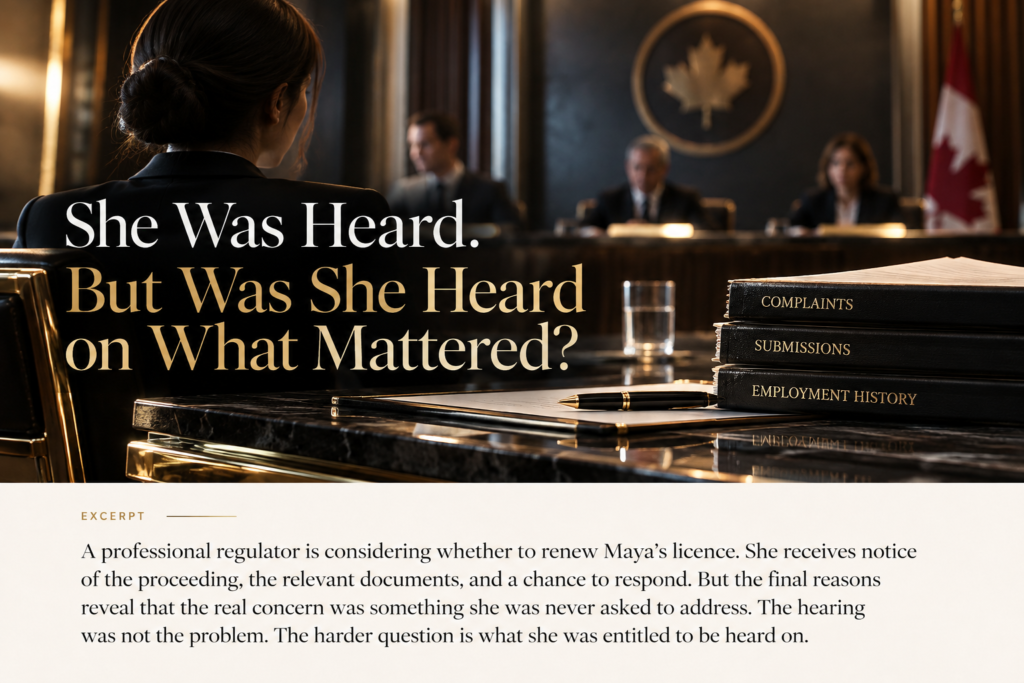
Procedural Fairness: Is a hearing always enough?

Affirmative Action and Section 15(2): Why Equality Does Not Always Mean Equal Treatment

The Charter Breach Is Obvious. What Exactly Should the Court Fix?

The Province Calls It Consumer Protection. Does That Matter?

Why Canada Is Rethinking the Bar Exam, and Why Candidates Should Care

The McKee Files | Episode 5: Who Decides What the Defence Gets to See? | AGP e-class™

The McKee Files | Episode 4: When Privacy Meets the Right to a Defence | AGP e-class™
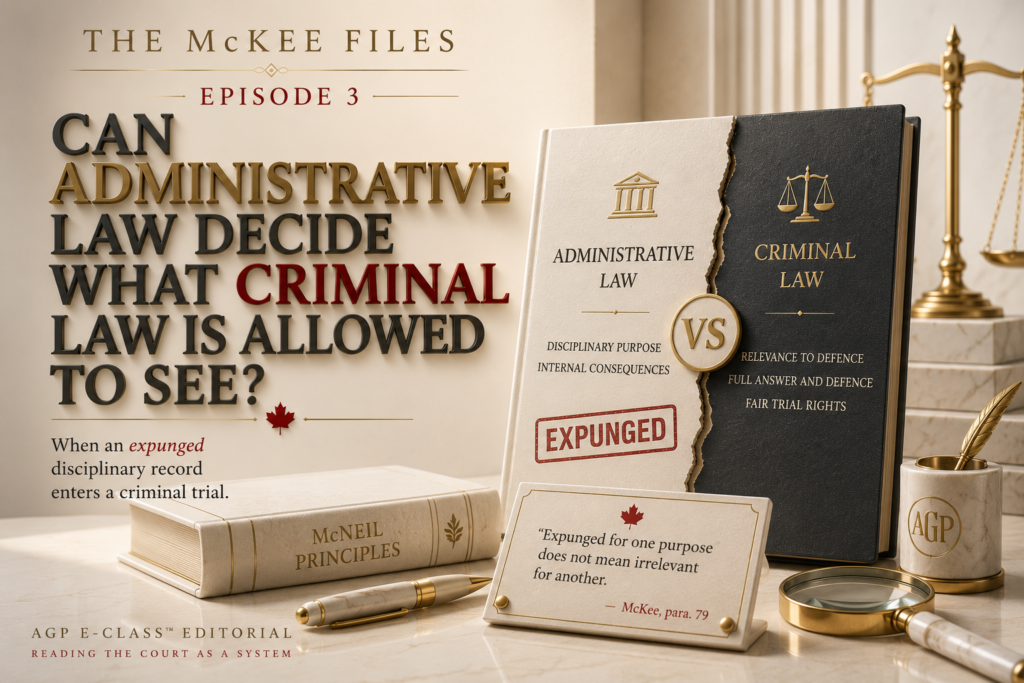
The McKee Files | Episode 3: Can Administrative Law Decide What Criminal Law Is Allowed to See?
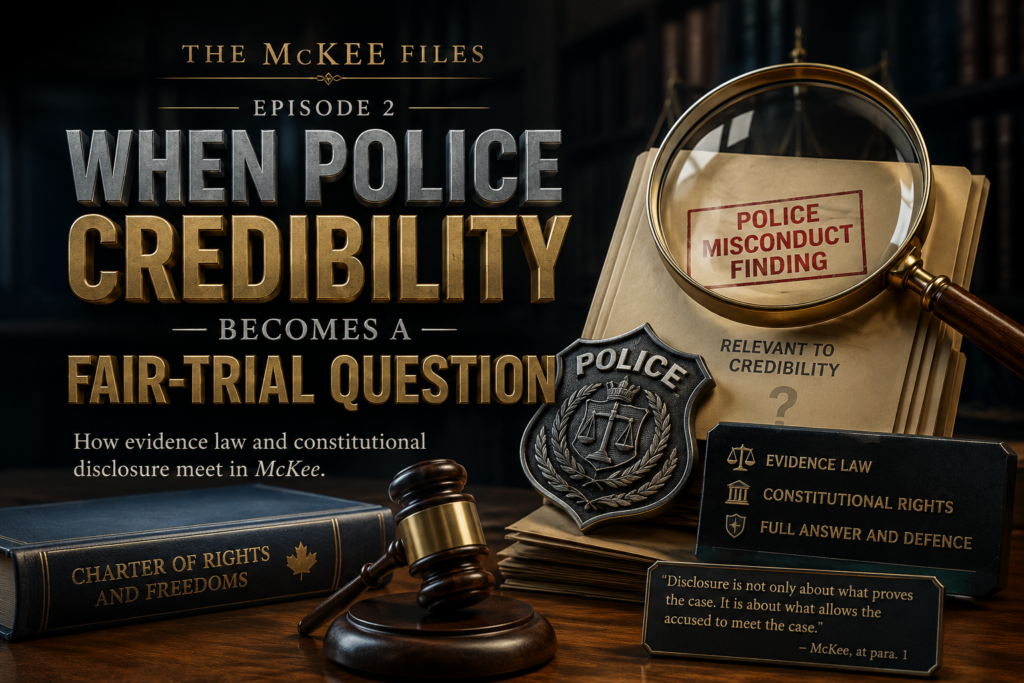
The McKee Files | Episode 2: When Police Credibility Becomes a Fair-Trial Question
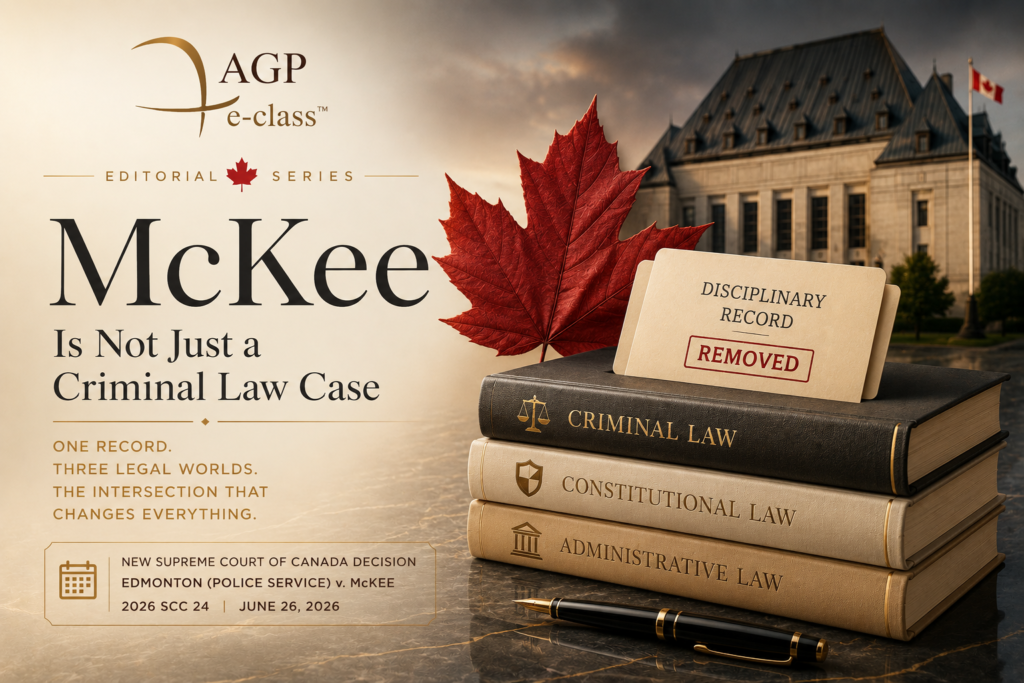
The McKee Files | Pilot: McKee Is Not Just a Criminal Law Case | AGP e-class™

Why Passive Reading Is Not Exam Preparation | AGP e-class™

Why Canadian Constitutional Law Exam Answers Fail Even When You Think You Know the Law

Why Canadian Constitutional Law Exam Feels Deceptive | AGP e-class™

Canadian Administrative Law Exam Is Not What You Think It Is | AGP – eclass™
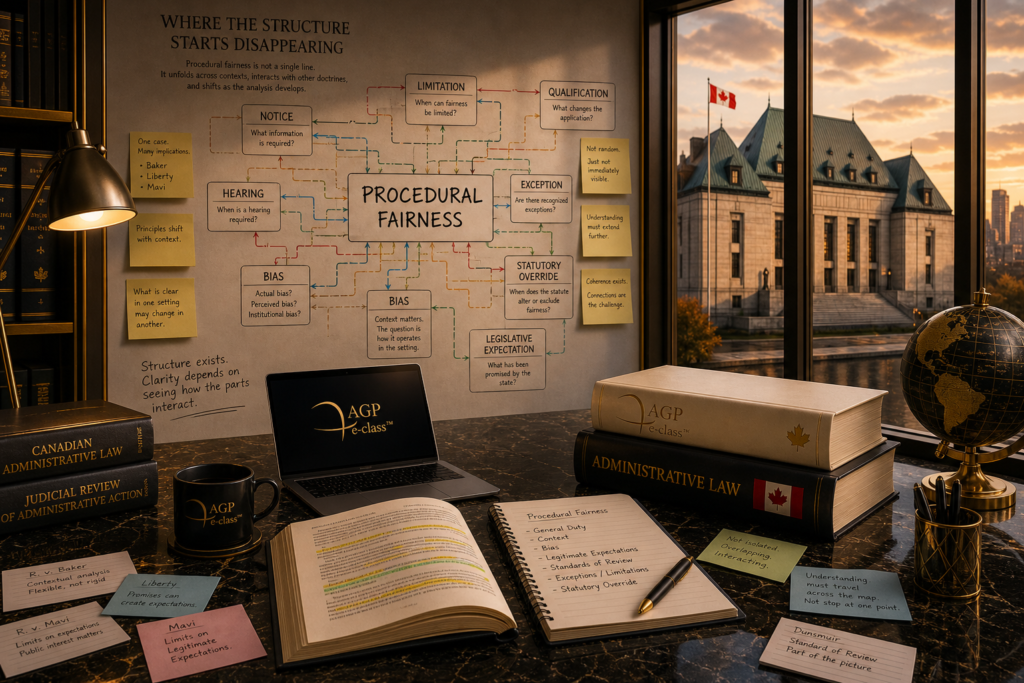
Why Procedural Fairness Often Feels Scattered | AGP e-class™

The Structure Behind Canadian Administrative Law | AGP e-class™ Lawbrary
AGP e-class™ Student Insight Briefing
Follow the public conversation
Editorial pieces, professional opportunities, cohort updates, and Canadian law pathway signals.
Receive selected student updates
Important notices, new Editorial pieces, cohort information, and timely professional signals.
Watch deeper legal briefings
Long-form guidance on Canadian law, the NCA pathway, legal reasoning, and professional readiness.