
Dear Canadian Law Student, Is Your Study Material Making You Think The Real Thing?
Why serious exam preparation cannot remain a passive read.
Dear Canadian law student,
Whether you are preparing for a JD exam, a Canadian law LLM exam, or an NCA exam, the deeper principle remains the same: legal exams do not reward you merely because you have read the law. They test whether you can use the law when facts are imperfect, time is limited, and legal judgment is required.
There is a quiet danger in legal preparation: the student may keep moving, while the mind remains still. Pages turn, passages are marked, files are saved, and the routine begins to look like discipline. But law does not become usable merely because it has been seen often.
At some point, serious preparation must “disturb” the comfort of recognition and demand something more from the student than continued reading.
This “disturbance” does not have to be loud. In serious legal material, it often appears quietly: an apparently settled rule begins to carry a condition; a simple proposition begins to depend on context; an exception changes the direction of the analysis; and the student is made to realize that law is not linear.
Good material does not merely place law before the student, or decorate the page with shallow points of engagement. It creates moments where the student can no longer continue reading without becoming legally awake. Serious study slows the student down at the exact point where careless preparation would move too quickly. It makes the student feel the weight of multiple factors including a condition, the danger of an exception, the importance of context, and the consequence of a legal distinction. It does not let the student confuse recognition with readiness.
That is where surface-level material quietly fails. It can make law appear manageable because it removes the pressure points. It can make preparation feel smooth because it avoids the very friction that legal exams often test. The student finishes the page with confidence, but not necessarily with judgment. The most dangerous material is not always the material that looks weak. In fact, sometimes such material looks helpful because it makes everything feel clear too soon.
It gives the student the comfort of understanding without the discipline of struggle. It turns legal difficulty into neat explanation, and neat explanation into premature confidence. However, legal exams rarely test law in the same clean form in which weak material presents it. They test the student at the point where the rule begins to bend, where facts disturb the comfort of the summary, and where the student must see the non-obvious.
This is why serious exam preparation cannot be built around passive reading. A law student does not become exam-ready simply by receiving more material, or by reading material that feels smooth. The real test of study material is whether it changes the student’s engagement with law. Does it make the student slower where the law demands care? Does it make the student alert to context? Does it create legal movement, or only legal familiarity?
👍🏻 Rule of thumb: if your material makes you confident before it has made you confront difficulty — be careful. That confidence may be premature.
This Is Where Your Seriousness Begins
Not in a dramatic way. Not in slogans. But in the quiet moment when the material stops giving you comfort and starts demanding effort from you.
You may want the law to feel simpler. You may want the material to confirm that you have understood enough. You may want preparation to feel smooth, organized, and reassuring. But serious legal preparation will not always give you that comfort immediately. Its not designed to. Sometimes it slows you down. Sometimes it makes a familiar rule feel less settled. And when put to test, sometimes it shows you that the rule felt comfortable because it had not yet been tested by facts. That is not a failure of the material. That may be the point at which the material finally begins doing its work.
👍🏼 Rule of thumb: material that only reassures you may keep you comfortable. Material that trains you may first make you uncomfortable in the right places.
The Choice Is Yours
In the end, you have to decide what kind of preparation you are willing to accept. Not loudly. Not for anyone else to see. Quietly, in the way you study.
You can choose material that makes preparation feel smooth. You can choose material that gives you the comfort of recognition. You can choose explanations that make the law feel settled before you have tested whether you can actually use it.
Or you can choose preparation that asks more from you.
Preparation that slows you down where the law requires care. Preparation that makes you notice context before you rush to a rule. Preparation that makes legal difficulty visible before the exam turns that difficulty into pressure.
The choice is not between “easy” and “hard” for the sake of it. The choice is between material that lets you remain passive and material that begins to make you legally active.
👍🏼 Rule of thumb: choose preparation that respects the difficulty of legal thinking, not preparation that only makes you feel comfortable with the law.
You do not need material that flatters your confidence. You need material that prepares your judgment.
Move from reading to real practice
More from the Editorial
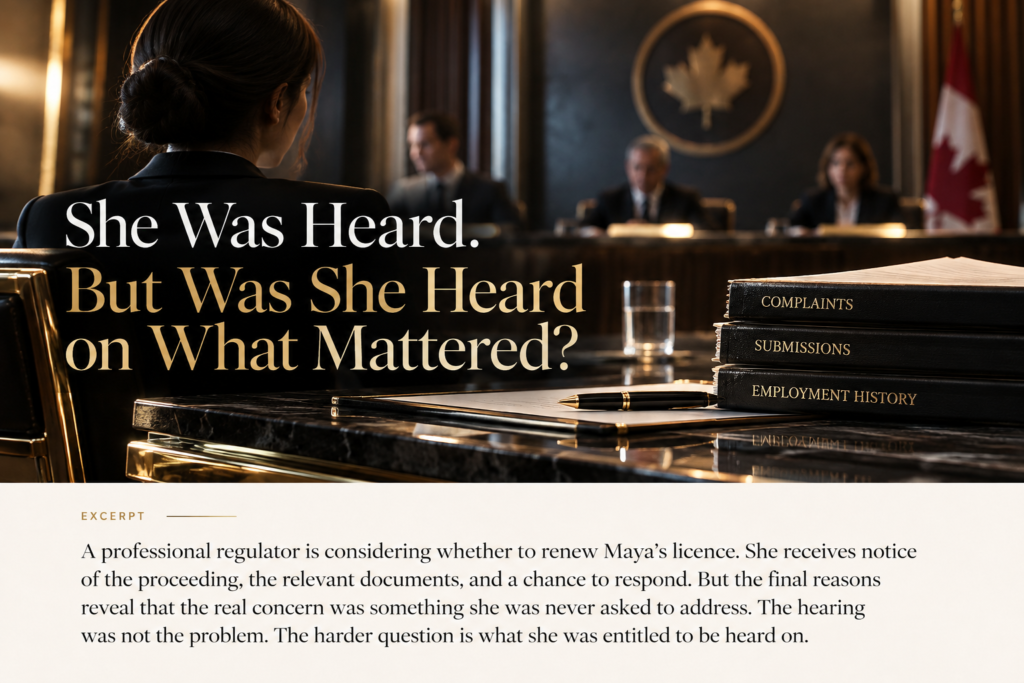
Procedural Fairness: Is a hearing always enough?
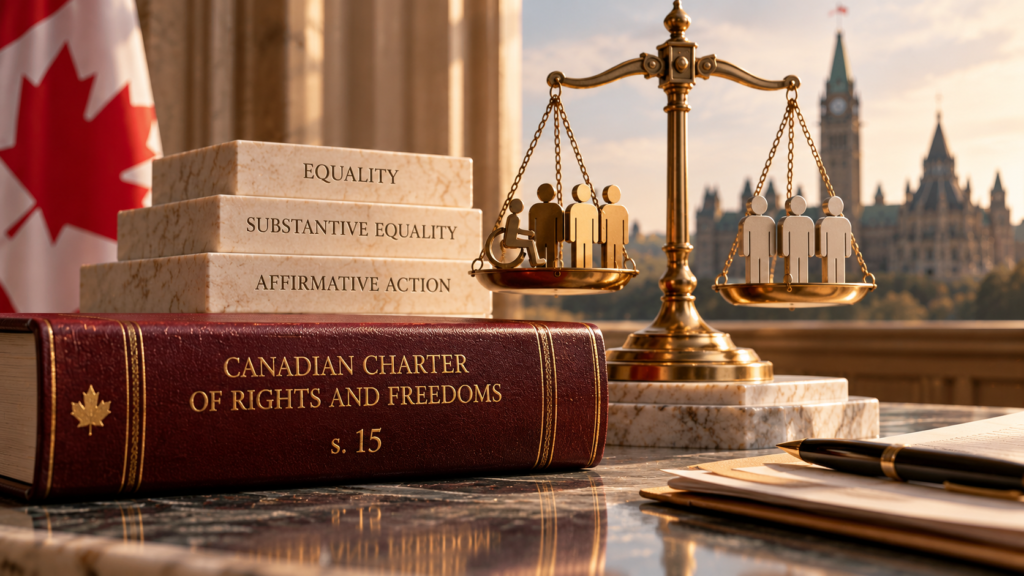
Affirmative Action and Section 15(2): Why Equality Does Not Always Mean Equal Treatment
The Charter Breach Is Obvious. What Exactly Should the Court Fix?
The Province Calls It Consumer Protection. Does That Matter?
Why Canada Is Rethinking the Bar Exam, and Why Candidates Should Care
The McKee Files | Episode 5: Who Decides What the Defence Gets to See? | AGP e-class™
The McKee Files | Episode 4: When Privacy Meets the Right to a Defence | AGP e-class™
The McKee Files | Episode 3: Can Administrative Law Decide What Criminal Law Is Allowed to See?
The McKee Files | Episode 2: When Police Credibility Becomes a Fair-Trial Question
The McKee Files | Pilot: McKee Is Not Just a Criminal Law Case | AGP e-class™
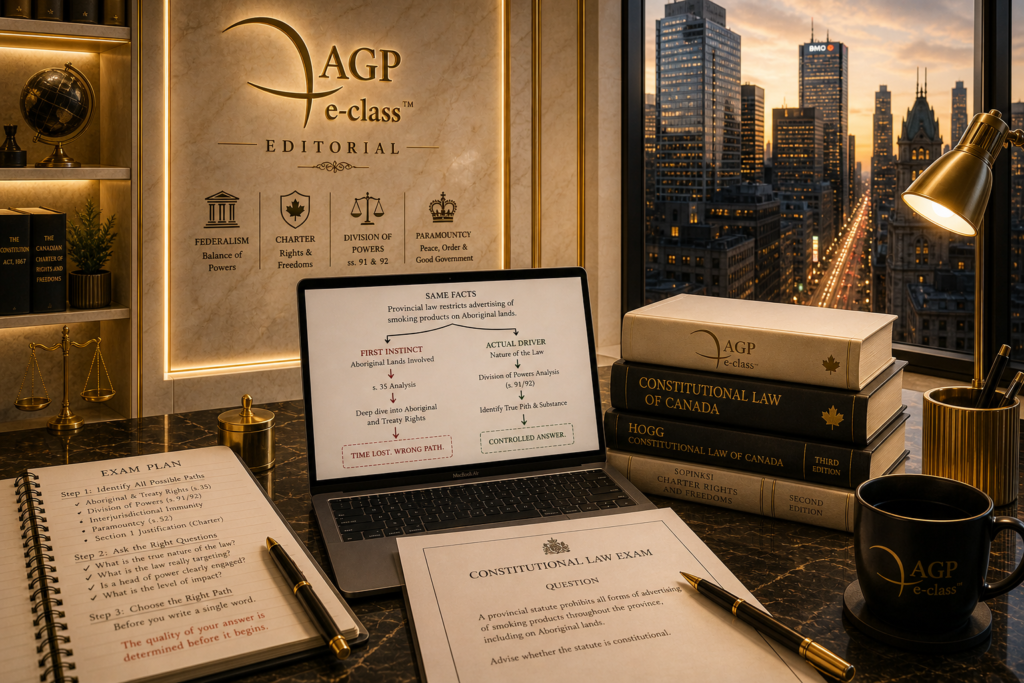
Why Canadian Constitutional Law Exam Answers Fail Even When You Think You Know the Law
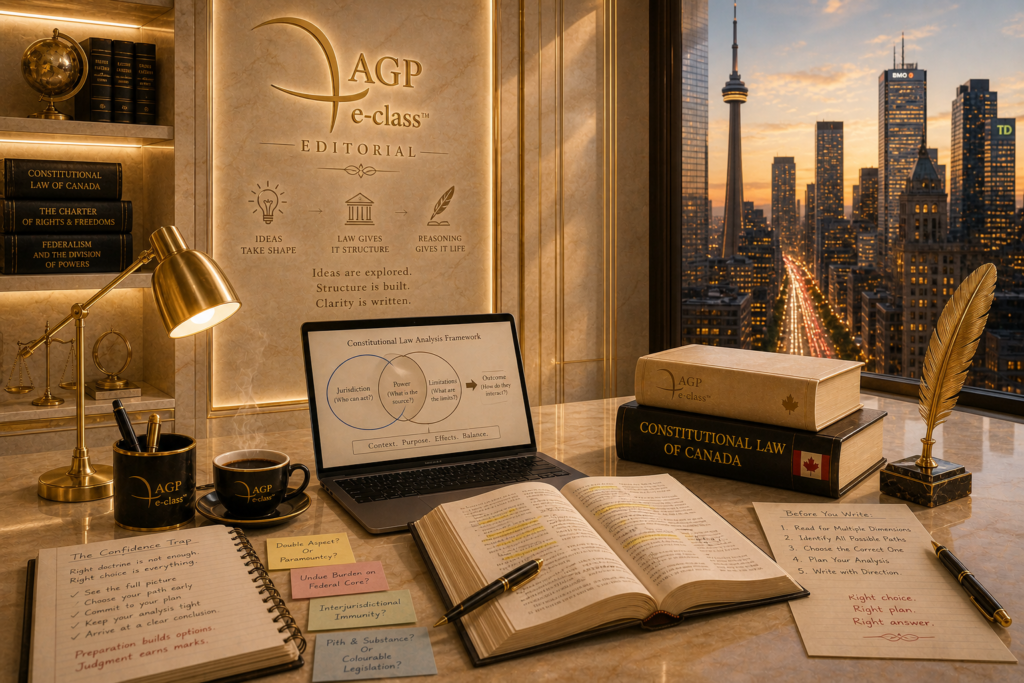
Why Canadian Constitutional Law Exam Feels Deceptive | AGP e-class™

Canadian Administrative Law Exam Is Not What You Think It Is | AGP – eclass™
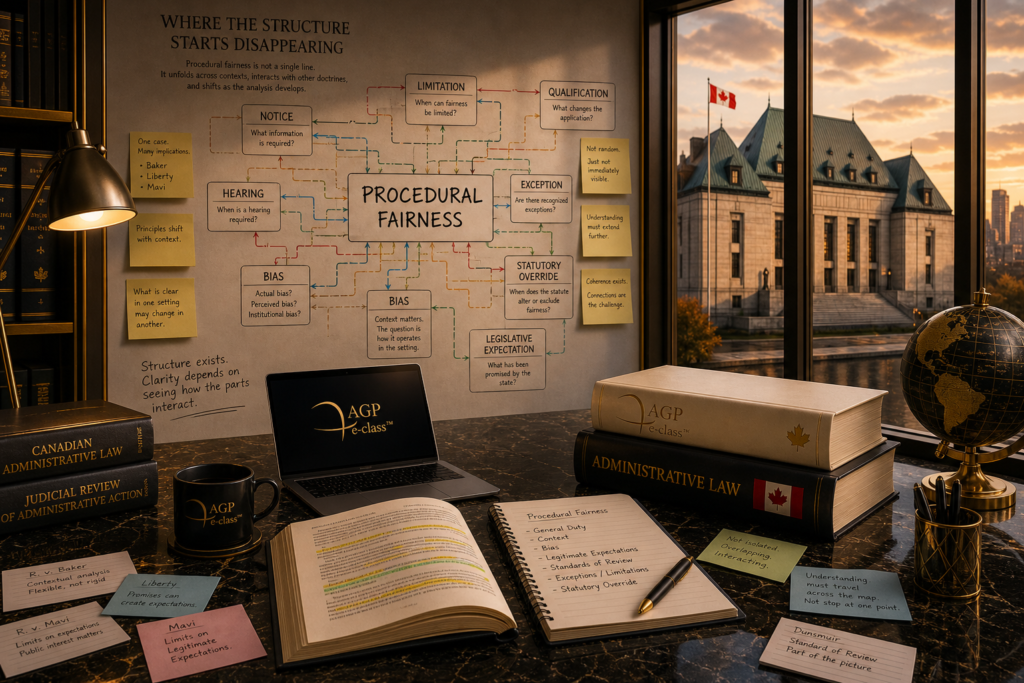
Why Procedural Fairness Often Feels Scattered | AGP e-class™
The Structure Behind Canadian Administrative Law | AGP e-class™ Lawbrary

Why Canadian Administrative Law Feels Confusing | AGP e-class™
AGP e-class™ Student Insight Briefing
Follow the public conversation
Editorial pieces, professional opportunities, cohort updates, and Canadian law pathway signals.
Receive selected student updates
Important notices, new Editorial pieces, cohort information, and timely professional signals.
Watch deeper legal briefings
Long-form guidance on Canadian law, the NCA pathway, legal reasoning, and professional readiness.