
The McKee Files | Episode 3
Can Administrative Law Decide What Criminal Law Is Allowed to See?
When an expunged disciplinary record enters a criminal trial
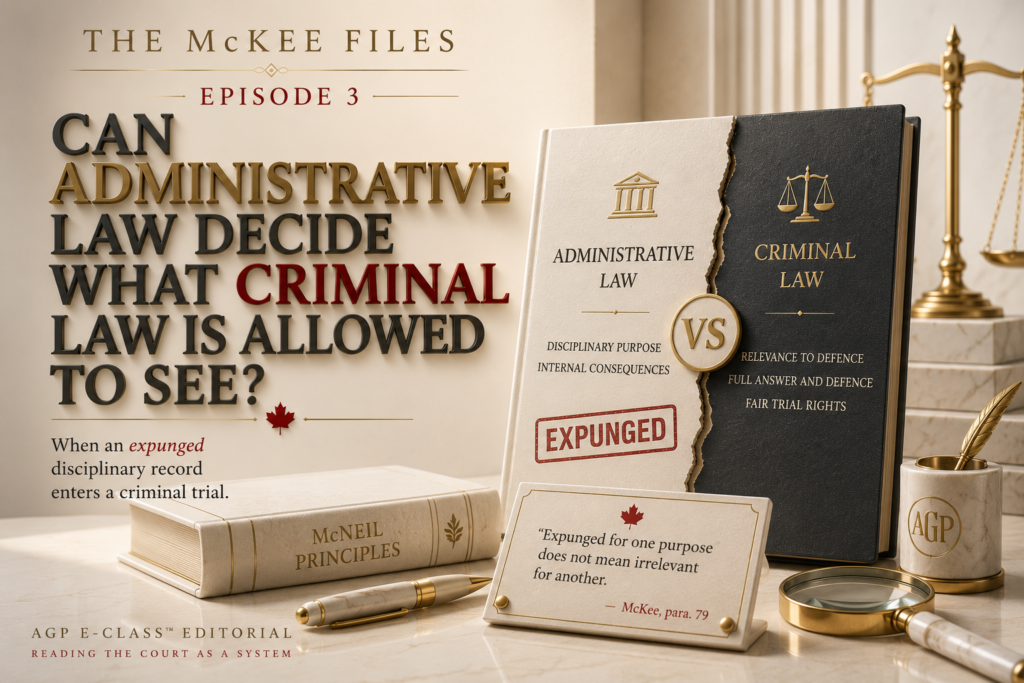
A police disciplinary system and a criminal trial serve very different purposes.
That distinction sounds obvious. In Edmonton (Police Service) v. McKee, however, it became decisive. The misconduct finding against the investigating detective had been removed from his disciplinary record under Alberta’s Police Service Regulation. The regulation allowed certain entries to be removed after the prescribed period and restricted their future use in disciplinary proceedings.
From an administrative perspective, that makes sense. A disciplinary regime may decide that an old finding should no longer follow an officer indefinitely.
But McKee was not a police disciplinary proceeding. He was an accused person facing criminal charges.
That changed the legal question.
The Supreme Court held at para. 79 that there was no principled reason to exclude an administratively expunged disciplinary finding from the ordinary McNeil disclosure framework. Criminal disclosure turns on relevance, not on the administrative status attached to a record.
That distinction is important.
Administrative law can determine what consequences a disciplinary finding continues to have within the disciplinary system. It does not necessarily determine what significance the same information may have somewhere else.
Suppose an old misconduct finding could realistically affect the credibility of an officer who played an important role in a criminal investigation. For disciplinary purposes, the officer may be entitled to have that finding removed from the record. But for the accused, the same information may assist in challenging testimony, questioning the reliability of the investigation or deciding how to conduct the defence.
The same information therefore performs two completely different legal functions. This is where administrative law meets constitutional criminal procedure.
The Court treated disclosure as flowing from the accused’s constitutional right to make full answer and defence. Once the information enters that constitutional inquiry, the purpose of the disciplinary rule cannot simply determine the result.
Administrative expungement changes the disciplinary status of the record. It does not rewrite the history underlying it.
More importantly, it cannot answer a question belonging to another legal regime: is this information relevant to the defence of a criminal prosecution?
🧠 The broader lesson in McKee.
Legal rules operate for particular purposes. A rule designed to give finality within an employment or disciplinary system should not automatically be assumed to produce the same consequence in evidence law, criminal procedure or constitutional law.
The word expunged sounds final, but the question is: is it?
McKee shows why lawyers should sometimes ask a second question: Expunged for what purpose?
Because once the answer changes, the legal consequence may change with it.
More from The McKee Files
The McKee Files | Pilot: McKee Is Not Just a Criminal Law Case | AGP e-class™
The McKee Files | Episode 2: When Police Credibility Becomes a Fair-Trial Question

The McKee Files | Episode 4: When Privacy Meets the Right to a Defence | AGP e-class™
The McKee Files | Episode 4 When Privacy Meets the Right to a Defense When…

The McKee Files | Episode 5: Who Decides What the Defence Gets to See? | AGP e-class™
Move from reading to real practice
More from the Editorial

Why Canadian Constitutional Law Exam Answers Fail Even When You Think You Know the Law

Why Canadian Constitutional Law Exam Feels Deceptive | AGP e-class™

Canadian Administrative Law Exam Is Not What You Think It Is | AGP – eclass™

Why Procedural Fairness Often Feels Scattered | AGP e-class™

The Structure Behind Canadian Administrative Law | AGP e-class™ Lawbrary

Why Canadian Administrative Law Feels Confusing | AGP e-class™
AGP e-class™ Student Insight Briefing
Follow the public conversation
Editorial pieces, professional opportunities, cohort updates, and Canadian law pathway signals.
Receive selected student updates
Important notices, new Editorial pieces, cohort information, and timely professional signals.
Watch deeper legal briefings
Long-form guidance on Canadian law, the NCA pathway, legal reasoning, and professional readiness.