
The Charter Breach Is Obvious. What Exactly Should the Court Fix?
Consider this:
A provincial statute allows a licensing authority to approve or refuse permits in the “public interest.”
Nothing in the statute refers to political views, criticism of government, or the content of an applicant’s speech.
An organization applies for a permit. The regulator refuses it.
Internal correspondence later reveals why: officials disliked the organization’s repeated public criticism of the provincial government and did not want to give it access to the regulated activity.
Assume the Charter violation is established.
The organization asks the court to strike down the statutory provision.
🤔 But why?
What exactly violated the Charter?
There are two things sitting in front of the court. There is the law that created the discretion.
And there is the decision made using that discretion.
Those are not necessarily the same constitutional problem.
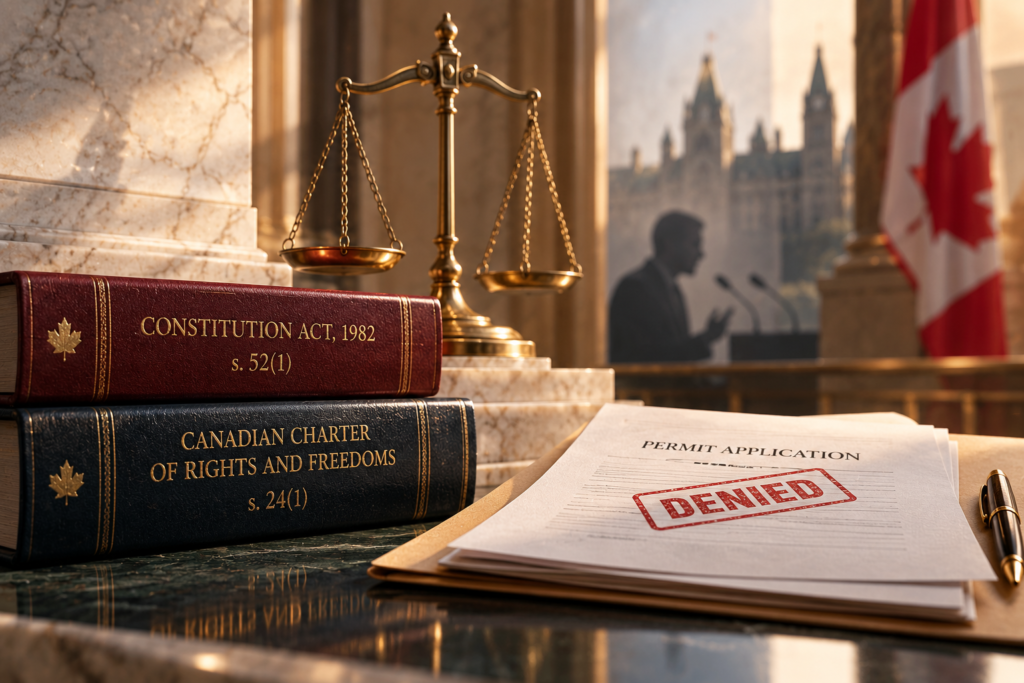
Section 52(1) of the Constitution Act, 1982 addresses laws that are inconsistent with the Constitution. Section 24(1) of the Charter, by contrast, permits a court of competent jurisdiction to grant an appropriate and just remedy to a person whose Charter rights have been infringed.
The Supreme Court has described the distinction in similar terms: s. 24(1) generally responds to unconstitutional governmental action under an otherwise lawful scheme, while s. 52(1) addresses unconstitutional laws.
That distinction makes our hypothetical uncomfortable. The legislature never instructed the regulator to punish government critics.
The regulator did that.
If the statutory power can be exercised constitutionally, why should the statute disappear because one decision-maker exercised it unconstitutionally?
Change one fact
Now suppose the statute says something slightly different.
A permit must be refused where the regulator considers an applicant’s public communications likely to “undermine confidence in provincial institutions.”
The same organization applies. The same permit is refused.
The same Charter right is engaged. But the constitutional problem may now have moved.
The regulator is no longer merely using a lawful discretion badly. The legislation itself may be directing the decision-maker toward the very constitutional problem complained of.
The applicant still suffered one refusal. Yet the object requiring constitutional repair may no longer be just the decision.
It may be the law.
That distinction matters
Section 52(1) does not simply provide a personalized escape from legislation for the individual before the court. Where a law itself is constitutionally inconsistent, the constitutional problem concerns the validity of that law.
In R. v. Ferguson, the Supreme Court rejected an attempt to use an individualized constitutional exemption as a substitute for confronting an unconstitutional law. The Court emphasized the different functions performed by s. 24(1) and s. 52(1).
And even once the problem is located in the legislation, another question remains.
What does it mean to repair the law?
Striking down the entire provision is not necessarily the only possibility. Canadian constitutional remedies can involve invalidity, suspended declarations, severance, reading down or, in appropriate circumstances, reading in. Schachter v. Canada illustrates that the remedial inquiry itself requires attention to the nature and extent of the constitutional inconsistency.
So finding the Charter breach does not automatically tell us what the court should do next.
Return to the first case
The regulator discriminated against the organization because of its expression.
Suppose everyone agrees that this was unconstitutional. That tells us something important about what happened to the applicant.
It does not yet tell us whether the legislature enacted an unconstitutional law.
And that distinction can change the remedy entirely. Students often treat remedies as the final step after the “real” Charter analysis has finished.
But sometimes the remedy forces a more fundamental question:
Where, exactly, is the constitutional wrong located?
👉🏻In the legislation?
👉🏻In the government action taken under it?
👉🏻Or, in a harder case, somewhere in the relationship between the two?
A Charter breach may tell us that something must be repaired.
It does not always tell us what.
Move from reading to real practice
More on Constitution Law
Affirmative Action and Section 15(2): Why Equality Does Not Always Mean Equal Treatment
The Province Calls It Consumer Protection. Does That Matter?
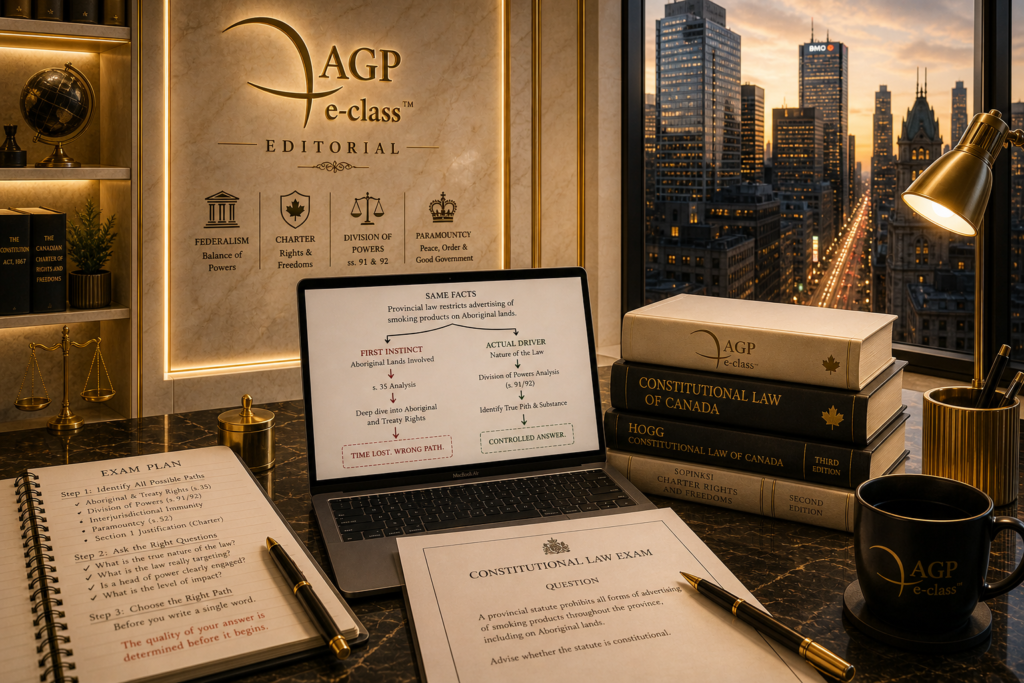
Why Canadian Constitutional Law Exam Answers Fail Even When You Think You Know the Law

Why Canadian Constitutional Law Exam Feels Deceptive | AGP e-class™
Continue Exploring the Editorial
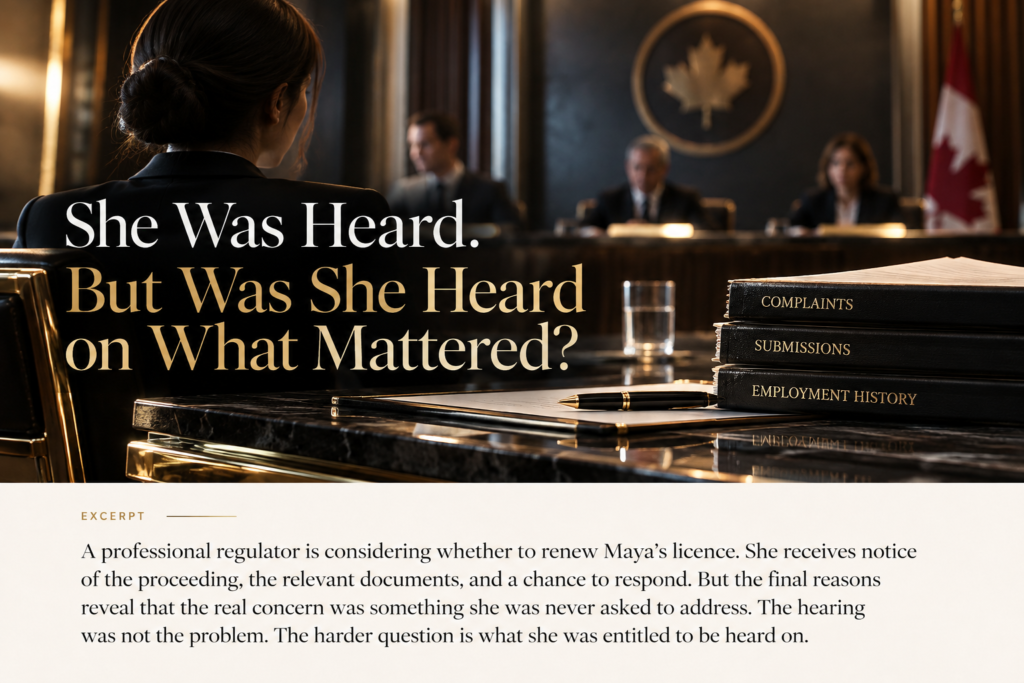
Procedural Fairness: Is a hearing always enough?
Affirmative Action and Section 15(2): Why Equality Does Not Always Mean Equal Treatment
The Province Calls It Consumer Protection. Does That Matter?
Why Canada Is Rethinking the Bar Exam, and Why Candidates Should Care
The McKee Files | Episode 5: Who Decides What the Defence Gets to See? | AGP e-class™
The McKee Files | Episode 4: When Privacy Meets the Right to a Defence | AGP e-class™
The McKee Files | Episode 3: Can Administrative Law Decide What Criminal Law Is Allowed to See?
The McKee Files | Episode 2: When Police Credibility Becomes a Fair-Trial Question
The McKee Files | Pilot: McKee Is Not Just a Criminal Law Case | AGP e-class™
Why Passive Reading Is Not Exam Preparation | AGP e-class™
Why Canadian Constitutional Law Exam Answers Fail Even When You Think You Know the Law
Why Canadian Constitutional Law Exam Feels Deceptive | AGP e-class™

Canadian Administrative Law Exam Is Not What You Think It Is | AGP – eclass™
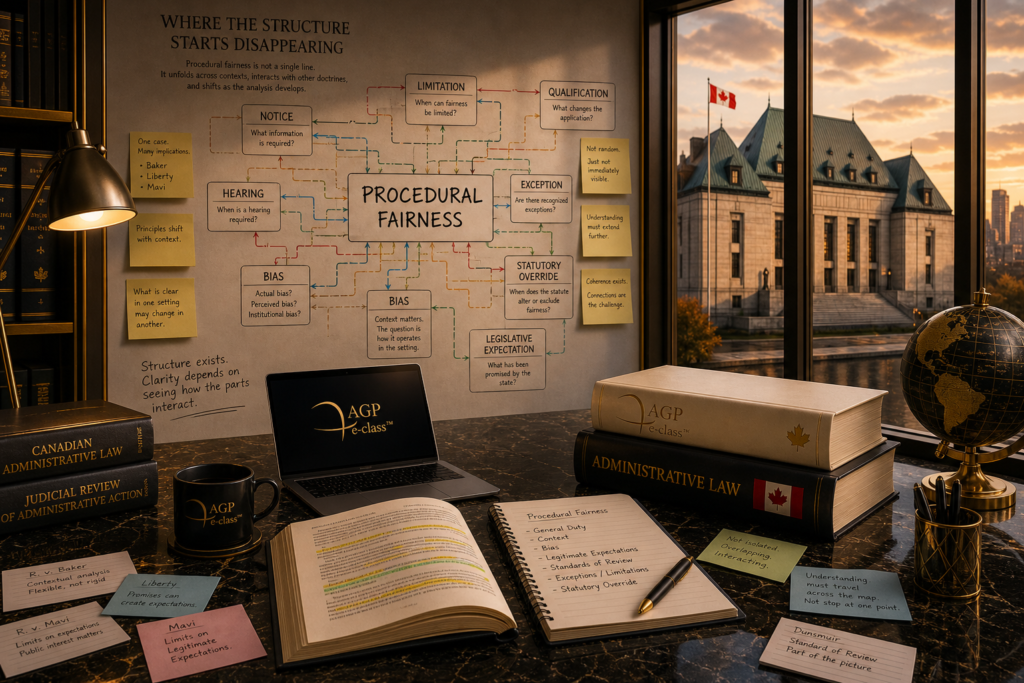
Why Procedural Fairness Often Feels Scattered | AGP e-class™

The Structure Behind Canadian Administrative Law | AGP e-class™ Lawbrary

Why Canadian Administrative Law Feels Confusing | AGP e-class™
AGP e-class™ Student Insight Briefing
Follow the public conversation
Editorial pieces, professional opportunities, cohort updates, and Canadian law pathway signals.
Receive selected student updates
Important notices, new Editorial pieces, cohort information, and timely professional signals.
Watch deeper legal briefings
Long-form guidance on Canadian law, the NCA pathway, legal reasoning, and professional readiness.