
The Province Calls It Consumer Protection. Does That Matter?
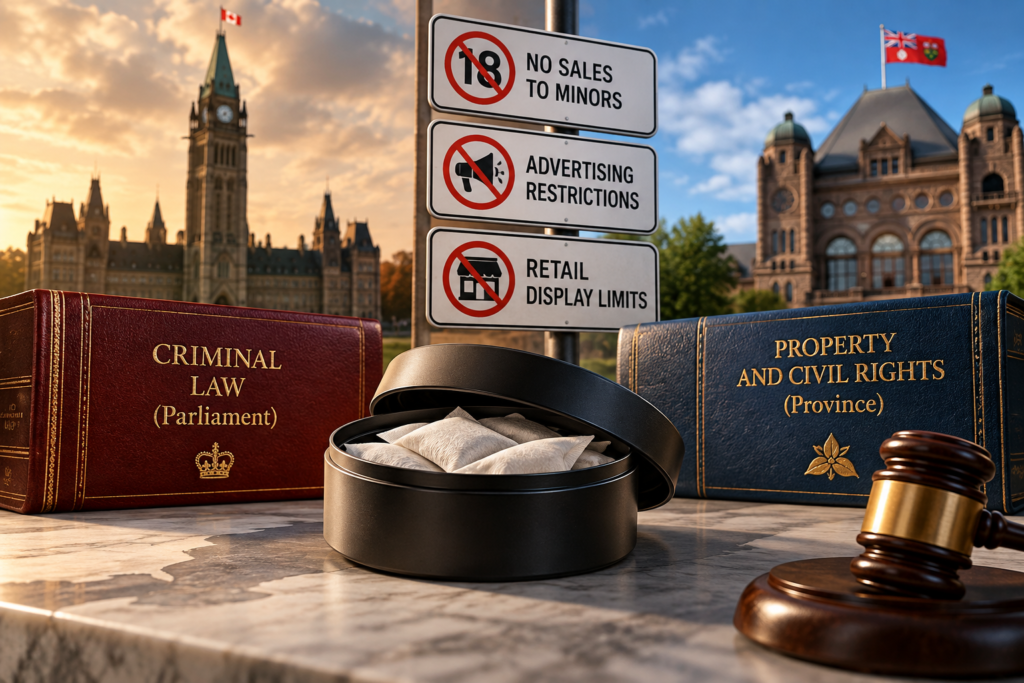
Consider this.
A province becomes concerned about a new nicotine-free stimulant pouch increasingly used by teenagers. It passes the Youth Consumer Protection Act.
The Act does three things. It prohibits sales to anyone under 18, restricts advertising and packaging, and prevents retailers from displaying the product near schools. Violations attract substantial fines.
The legislation repeatedly describes its objective as consumer protection and the regulation of retail trade.
A manufacturer challenges the Act.
Its argument is simple: this is not really consumer protection. The province has effectively decided that a particular product is socially harmful and has created prohibitions backed by penalties to suppress its use. That, the manufacturer argues, looks much more like Parliament’s criminal law power.
So what is the Act actually about?
The label does not answer the question
It is tempting to begin with the title of the statute. Consumer protection. Retail sales. Local businesses.
Those descriptions immediately pull the legislation toward provincial jurisdiction. But Canadian federalism does not allow a legislature to determine the constitutional character of its own legislation simply by naming it.
When courts identify the validity of a law, they examine its purpose and effects to determine its true character. The inquiry is substantive rather than merely formal.
That changes our hypothetical.
Suppose government documents reveal that officials were not particularly concerned about misleading consumers or regulating commercial relationships. Their stated objective was to suppress use of the product because they believed it posed a serious social and health risk.
Does that change what the Act is?
Perhaps.
But now change one fact again.
Assume the legislation does not prohibit adults from possessing or consuming the product at all. It regulates only who may sell it, where it may be displayed, and how it may be marketed.
Now the statute begins to look different again.
🧠 Same product. Different constitutional description.
This is where division of powers becomes more difficult than asking whether a subject belongs to Parliament or the provinces.
The Constitution does not allocate every real-world activity exclusively to one government.
The Supreme Court has expressly recognized that the same subject may possess both federal and provincial aspects. A valid provincial law can therefore affect something that Parliament may also validly regulate, depending upon the constitutional perspective from which each legislature is acting.
So the fact that Parliament could regulate a dangerous product does not itself establish that the province cannot regulate its retail sale.
But the opposite is equally important. Calling something retail regulation does not necessarily make it so.
In R. v. Morgentaler, the Supreme Court looked beyond the formal appearance of Nova Scotia legislation and examined its background, purpose and practical operation when determining its true constitutional character. The case illustrates why legislative form cannot end the inquiry.
And that produces the real problem in our hypothetical.
Imagine two statutes containing almost identical restrictions. One is genuinely directed toward regulating commercial transactions involving minors.
The other uses commercial regulation as the vehicle for suppressing conduct that the legislature believes should not occur at all.
The words on the page might look remarkably similar. Their constitutional character might not be.
The harder question
Students often approach division of powers by asking: Which head of power covers this subject?
But sometimes that is not yet the constitutional question.
Before deciding who has authority over a law, a court has to decide what the law constitutionally is.
And that decision may itself determine almost everything that follows. So return to our Youth Consumer Protection Act.
👉🏻Is it regulation of retail commerce with incidental consequences for public health?
👉🏻Is it public-health legislation operating through commercial restrictions?
👉🏻Or is consumer protection merely the legal form chosen for what is, in substance, a prohibition directed at perceived harmful conduct?
The Constitution does not answer that question by reading the title of the Act.
And neither should we.
Move from reading to real practice
More on Constitution Law
Affirmative Action and Section 15(2): Why Equality Does Not Always Mean Equal Treatment
The Charter Breach Is Obvious. What Exactly Should the Court Fix?
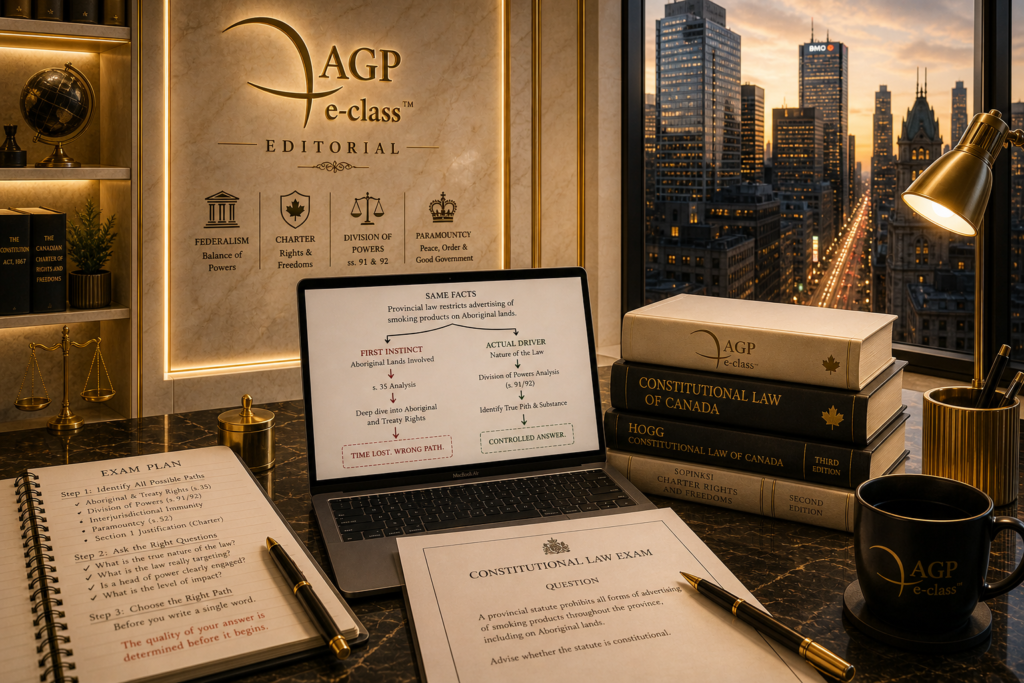
Why Canadian Constitutional Law Exam Answers Fail Even When You Think You Know the Law

Why Canadian Constitutional Law Exam Feels Deceptive | AGP e-class™
Continue Exploring the Editorial
Procedural Fairness: Is a hearing always enough?
Affirmative Action and Section 15(2): Why Equality Does Not Always Mean Equal Treatment
The Charter Breach Is Obvious. What Exactly Should the Court Fix?
Why Canada Is Rethinking the Bar Exam, and Why Candidates Should Care
The McKee Files | Episode 5: Who Decides What the Defence Gets to See? | AGP e-class™
The McKee Files | Episode 4: When Privacy Meets the Right to a Defence | AGP e-class™
The McKee Files | Episode 3: Can Administrative Law Decide What Criminal Law Is Allowed to See?
The McKee Files | Episode 2: When Police Credibility Becomes a Fair-Trial Question
The McKee Files | Pilot: McKee Is Not Just a Criminal Law Case | AGP e-class™
Why Passive Reading Is Not Exam Preparation | AGP e-class™
Why Canadian Constitutional Law Exam Answers Fail Even When You Think You Know the Law
Why Canadian Constitutional Law Exam Feels Deceptive | AGP e-class™

Canadian Administrative Law Exam Is Not What You Think It Is | AGP – eclass™
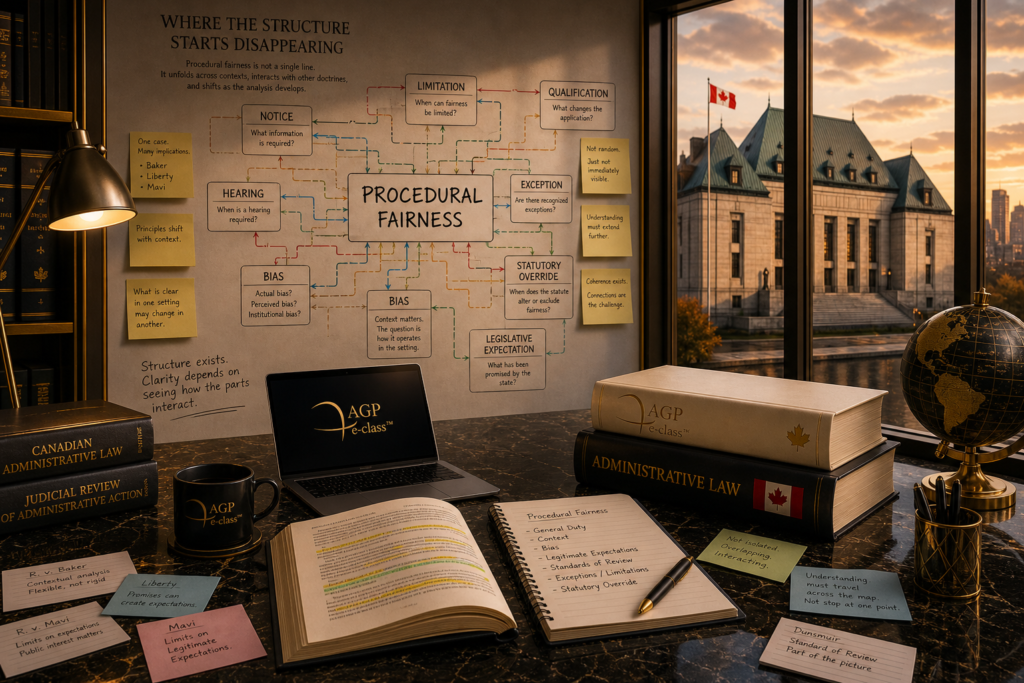
Why Procedural Fairness Often Feels Scattered | AGP e-class™

The Structure Behind Canadian Administrative Law | AGP e-class™ Lawbrary

Why Canadian Administrative Law Feels Confusing | AGP e-class™
AGP e-class™ Student Insight Briefing
Follow the public conversation
Editorial pieces, professional opportunities, cohort updates, and Canadian law pathway signals.
Receive selected student updates
Important notices, new Editorial pieces, cohort information, and timely professional signals.
Watch deeper legal briefings
Long-form guidance on Canadian law, the NCA pathway, legal reasoning, and professional readiness.